what is liminality? van gennep, turner, and halloween
the word comes from the latin for threshold. the idea comes from a french folklorist in 1909. what liminality means, what victor turner did with it, and why halloween is the wrong-but-useful example.
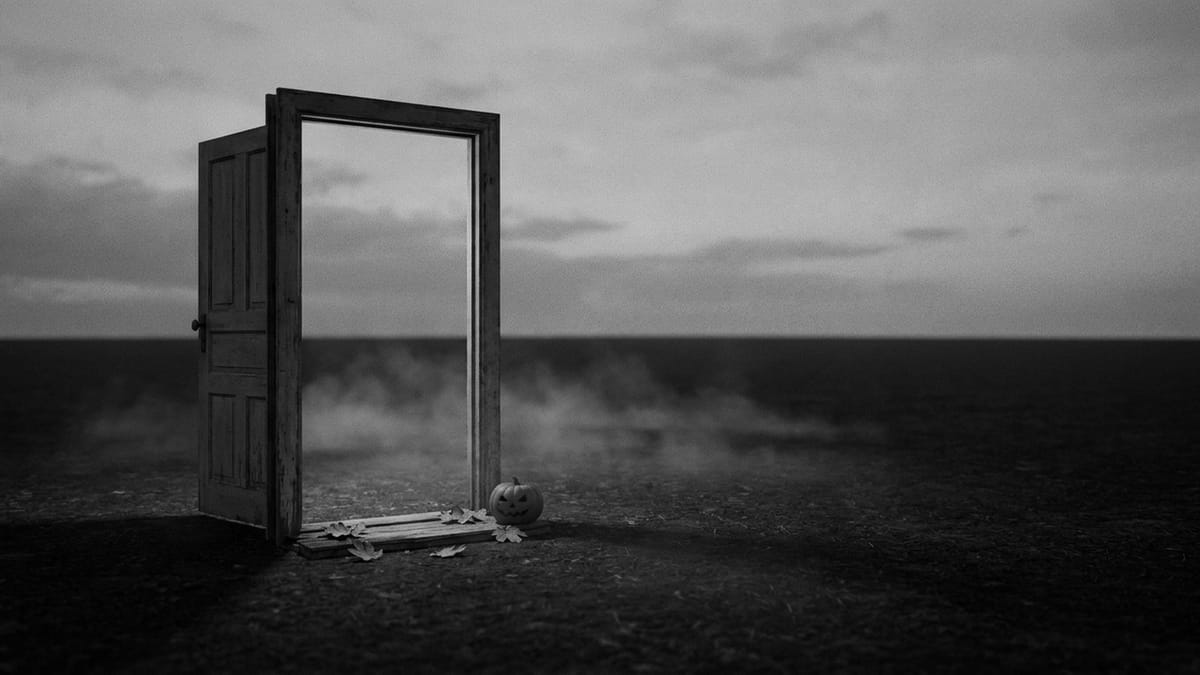
liminality is the in-between stage of a rite of passage: the moment after you've left your old status and before you've been given the new one. the word comes from the latin limen, threshold. the french folklorist arnold van gennep named the pattern in 1909, and the british anthropologist victor turner spent much of the 1960s and '70s arguing that the threshold is where the interesting things happen. if you've ever stood in a doorway at a party and felt like you weren't quite anyone yet, you already know the feeling the word is trying to name.
that's the definition. the rest of this essay is about why the definition keeps escaping its box.
van gennep's three doors
in 1909 arnold van gennep published the first substantial interpretation of rites of passage as a class of phenomena, and coined the phrase itself. working from a wide survey of societies, he argued that these rites have three consecutive parts: separation, transition and reincorporation. he also called them the preliminal, liminal and postliminal stages: before, at and past the threshold.
the shape is simple. first you are cut off from who you were. then you spend a while as no one in particular. then you are brought back in under a new name: adult, wife, widow, priest, initiate. van gennep's point was that the ceremonies exist to get people through that middle part without breaking the society around them.
birth, coming of age, marriage and death are the obvious examples, and death rites in particular tend to show all three stages clearly. but the structure turns up anywhere a society needs to move a person from one box to another. graduations, retirements, fraternity initiations: all of them are separation, a strange middle, and a return.
turner and the middle that won't stay put
victor turner picked up the middle stage and refused to put it down. in "betwixt and between: the liminal period in rites de passage" (first given in 1964 and collected in the forest of symbols, 1967), and then in the ritual process: structure and anti-structure (1969), he argued that the liminal phase isn't just a corridor. it's a different kind of social space.
his most quoted line is about the people standing in it: "liminal entities are neither here nor there; they are betwixt and between the positions assigned and arrayed by law, custom, convention, and ceremonial."
two things happen in that space, in turner's account. the first is that ordinary rules get suspended or reversed. the person about to become king is treated like a commoner. initiates are stripped of rank. turner called this anti-structure. the second is something he called communitas: the direct, unranked bond that forms between people who are going through the threshold together, when nobody has a title yet.
turner's sharpest move was to treat liminality as more than a support beam for the existing order. he argued that because the threshold sets people outside their statuses, it also lets them experiment with other ways of relating, and that this is how rituals carry social change. structure organizes people. liminality reminds them that the organization is made up.
if that sounds familiar, it's because it's the same structural position i've been tracing in the liminal caste series: a group of people kept permanently at the threshold so everyone else doesn't have to stay there.
liminal vs liminoid
in 1974 turner added a distinction that matters a lot now. in traditional societies, he said, liminal experiences are obligatory and collective: everyone of a certain age goes through the initiation whether they want to or not. in modern industrial societies, the closest equivalents are optional, individual and often commercial: art, theater, sport, festivals, leisure. he called these liminoid, "liminal-like."
the distinction is useful because it keeps the word honest. a coming-of-age rite that transforms your legal and social status is liminal. a weekend at a music festival that makes you feel briefly transformed is liminoid. both share the shape. only one of them actually changes who you are when you get home.
it's also the frame i'd use for the internet as the new liminal space: a place where people can be no one in particular, try on identities, and form communitas with strangers, without any guarantee of a return.
so is halloween liminal?
sort of, and the "sort of" is the interesting part.
the old story says halloween comes from samhain, the celtic festival marking the end of summer and the start of winter, celebrated on october 31 or november 1. it was believed that during that seasonal transition, spirits came into the world of the living. folklore from ireland and wales suggests samhain was imagined as a time when the barrier between the realm of the spirits and the realm of the living opened. that is about as literal a threshold as you can get.
but the story is messier than the greeting cards. very little can be said with certainty about ancient samhain because the evidence is sparse; most of what we know comes from christian writers or much later observers. the christian holidays of all saints' and all souls' were established on those dates in the 9th century, and britannica's account says they developed independently of samhain. modern halloween comes from a mix of both, and it's unclear which customs, if any, are true samhain survivals. the encyclopedia's own summary is the best line on the subject: just as samhain is said to have blurred the boundaries between the living and the dead, halloween blurs the boundaries between celtic and christian history.
so halloween is a festival about thresholds whose own origins sit on a threshold. that feels right.
in turner's terms, though, modern halloween is liminoid rather than liminal. nobody comes back from trick-or-treating with a new legal status. what halloween keeps is the form of the liminal: the costume that suspends your ordinary identity, the permission to reverse the usual rules (children demand things from adults; adults dress as monsters), and the brief communitas of a street full of strangers playing along. the reversal isn't new. anthropologists have long noted that rites of passage often prescribe the opposite of ordinary behavior: clothing worn inside out or backward, or the clothing of another sex. the costume is old technology.
why the word keeps escaping
"liminal" now gets used for empty malls at 2 a.m., airport gates, the week between christmas and new year. most of that is loose, and some of it is just a mood. but the reason the word travels is that the structure it names is real. any time you've been detached from one status and not yet given another, you are in it: between jobs, between relationships, between diagnoses, between versions of yourself.
what van gennep saw is that societies build rituals to carry people across. what turner saw is that the crossing itself is where people meet each other without their titles. and what the liminal caste material keeps showing is that when a culture stops building the bridges, the people stuck in the middle don't disappear. they just stop being seen.
halloween, at least, still gives everyone one night a year in the doorway.
sources
- bobby c. alexander and edward norbeck, "rite of passage," encyclopaedia britannica. britannica
- the editors of encyclopaedia britannica, "samhain." britannica
- arnold van gennep, les rites de passage (1909); english translation the rites of passage (1960).
- victor turner, "betwixt and between: the liminal period in rites de passage," in the forest of symbols (1967).
- victor turner, the ritual process: structure and anti-structure (1969).
- victor turner, "liminal to liminoid, in play, flow, and ritual," rice university studies 60, no. 3 (1974).