the internet as the new liminal space
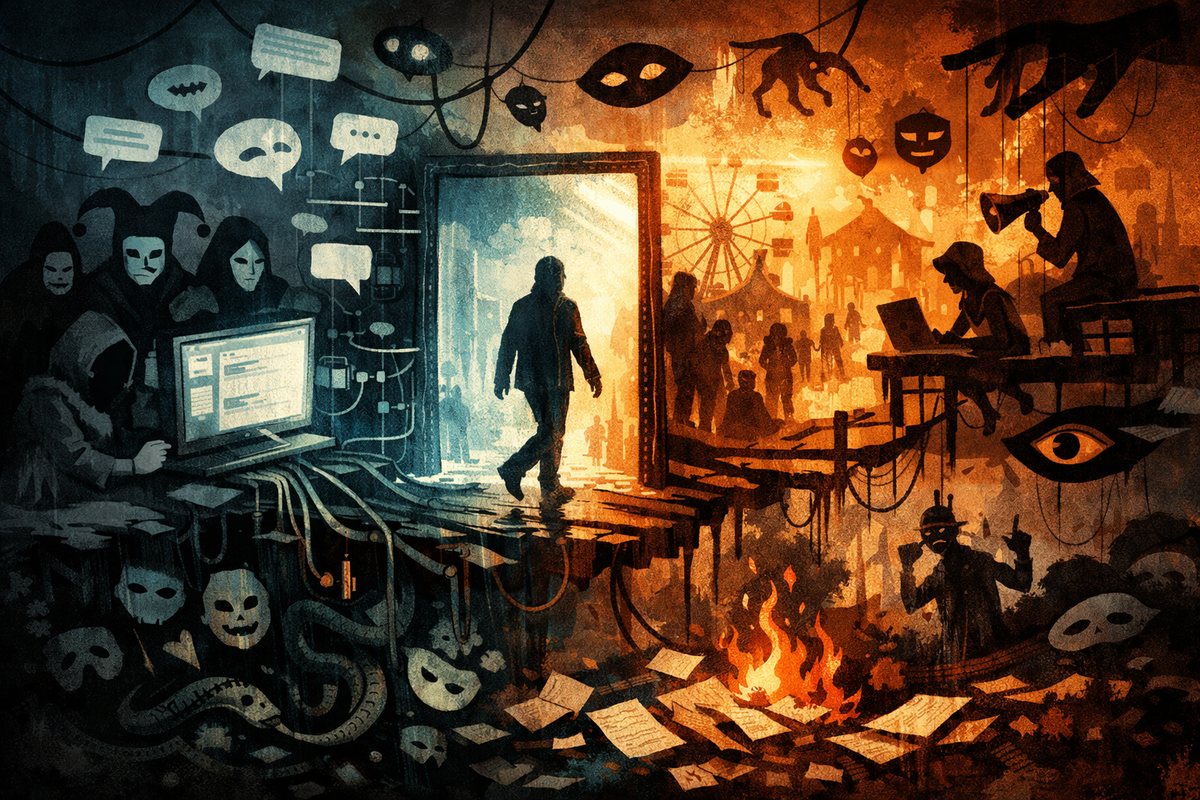
every time a society loses one container for liminal function, the function starts looking for another. that is one of the simplest lessons of the series. the internet is not identical to an older caste formation, and i do not want to be sloppy enough to say that anonymous accounts are literally the new Dom or the new Griot or the new fool. what the internet does offer, however, is a new threshold environment in which some of the same social mechanics reappear very quickly. masked speech. unstable identity. dangerous truth mixed with fraud. satire, prophecy, cruelty, witness, rumor, spectacle, collective release, and temporary publics formed out of people who are near one another without belonging to one another in the old settled way. (for the anthropology behind the word itself, see what is liminality?)
this is why the internet feels so spiritually filthy and so necessary at once. it is performing liminal work under modern technical conditions. it lets material move that official public speech cannot or will not carry. it also lets poison move. historically that combination is not exceptional. it is what liminal spaces do. the fairground could heal and swindle. the fool could tell truth and degrade into cruelty. the carnival could relieve pressure and unleash sadism. anonymous networked publics are not a clean break from that history. they are its digital mutation.
the mask matters first. a pseudonym, burner, avatar, or faceless account changes the cost of speech. what cannot be said under ordinary employment, family, reputation, and institutional consequence may be said from behind the mask. that is the old fool’s cap in technical form. the center hates it for obvious reasons. the center also repeatedly learns things from it it would not learn otherwise.
the public outside the ordinary public
the internet produces publics that are both more dispersed and more immediate than the old village square or fairground. strangers gather under handles rather than bodies. status markers are scrambled and reintroduced under new terms. speech can move faster than formal institutions can metabolize it. mockery, witness, confession, leak, conspiracy, subculture-building, and collective improvisation all happen in the same thread. this is a recipe for degradation if one expects clean deliberative citizenship. it is a recipe for liminal function if one knows the older archive.
what matters is not that online life is good. what matters is that online life makes obvious how much official public culture depends on unofficial threshold spaces to process what it cannot host gracefully. anonymous subcultural zones produce jokes, moral panic, whistleblowing, innovation, scapegoating, witness, cruelty, solidarity, and new language at once. that is exactly the kind of mixed output liminal systems have always produced.
why marginal populations arrive early
another continuity is who finds refuge there first. people at odds with ordinary social readability, queer users in earlier internet formations, autistic users, stigmatized subcultures, obsessive specialists, political dissidents, anonymous grief communities, sexual minorities, people who need the mask because ordinary public life is too punishing, all of them recognize the threshold quickly. this does not make the internet innocent. it means liminal spaces attract those who need angle.
that attraction is one reason online worlds feel both emancipatory and toxic. the same mask that lets necessary speech happen also lets predation, fantasy, cruelty, and derangement scale. again: not a new problem. only a technically amplified one.
the truth-and-fraud mix
what makes the internet especially recognizable in series terms is the old mixture of truth and fraud. rumor, leak, confession, half-knowledge, insider speech, counterfeit charisma, prophetic thread, schizo speculation, witness, scam, street report, satire, all arriving together. the modern mind hates this because it wants to separate the valid channel from the corrupted one in advance. the liminal archive keeps showing that such purity rarely exists where difficult social truth actually moves. it moves in bad neighborhoods of speech.
that is not a celebration. it is a recognition. if you eliminate every impure threshold channel, you do not get only reasoned civic discourse. you get official speech plus whatever reality cannot find a route in. then the blocked material returns elsewhere, usually uglier.
platform modernity as failed carnival management
social platforms are, among other things, modern institutions trying to benefit from liminal energy while pretending they can keep only the profitable or engaging parts. that was always impossible. carnival without obscenity is not carnival. the fool without insult is not fool. anonymous speech without cruelty is not how anonymous speech has ever worked at scale. the platform wants traffic, revelation, humor, subcultural heat, and spontaneous language invention without destabilization. that is the same fantasy older centers had about the liminal role. it never works.
what the internet clarifies
the internet clarifies the series because it proves the function survives even when hereditary caste dissolves. the social need for masked truth, unstable boundary space, temporary inversion, and dangerous public feeling remains. the container changes. the mask becomes technical rather than ritual. the crowd becomes distributed rather than local. the outer band becomes a shifting relation to platforms and handles rather than a fixed village edge. but the old logic is still there.
the final essay asks the direct present-tense question: who carries the function now. not only online, but across the full modern field.
the answer cannot simply be the internet because no one container now holds what older liminal formations often held together. but the network reveals the need in fluorescent light. masked speech, unstable publics, revelation mixed with fraud, collective feeling too dangerous for official discourse; once again the social order finds itself needing what it cannot quite bless.
that is why online culture swings so wildly between moral panic and compulsive dependence. everyone says the space is filthy, addictive, corrosive, unserious, and untrustworthy. everyone keeps returning because too much of contemporary revelation, witness, style, and unsanctioned truth now moves there first. the old pattern returns under new infrastructure and the same old shame.
This is Part 18 of the liminal caste series.
Previous: the griot in the diaspora | Hub: the liminal caste | Next: who carries the function now