who carries the function now
the old liminal caste does not return in one piece. once modernity has dissolved, criminalized, aestheticized, bureaucratized, or redistributed the older roles, the function comes back in fragments. that is the shape of the present. no single population now carries death work, memory work, truth work, and boundary work together in the way some older liminal formations did. instead the burden is split across institutions and precarious specialists who often do not know they are holding adjacent pieces of the same inheritance.
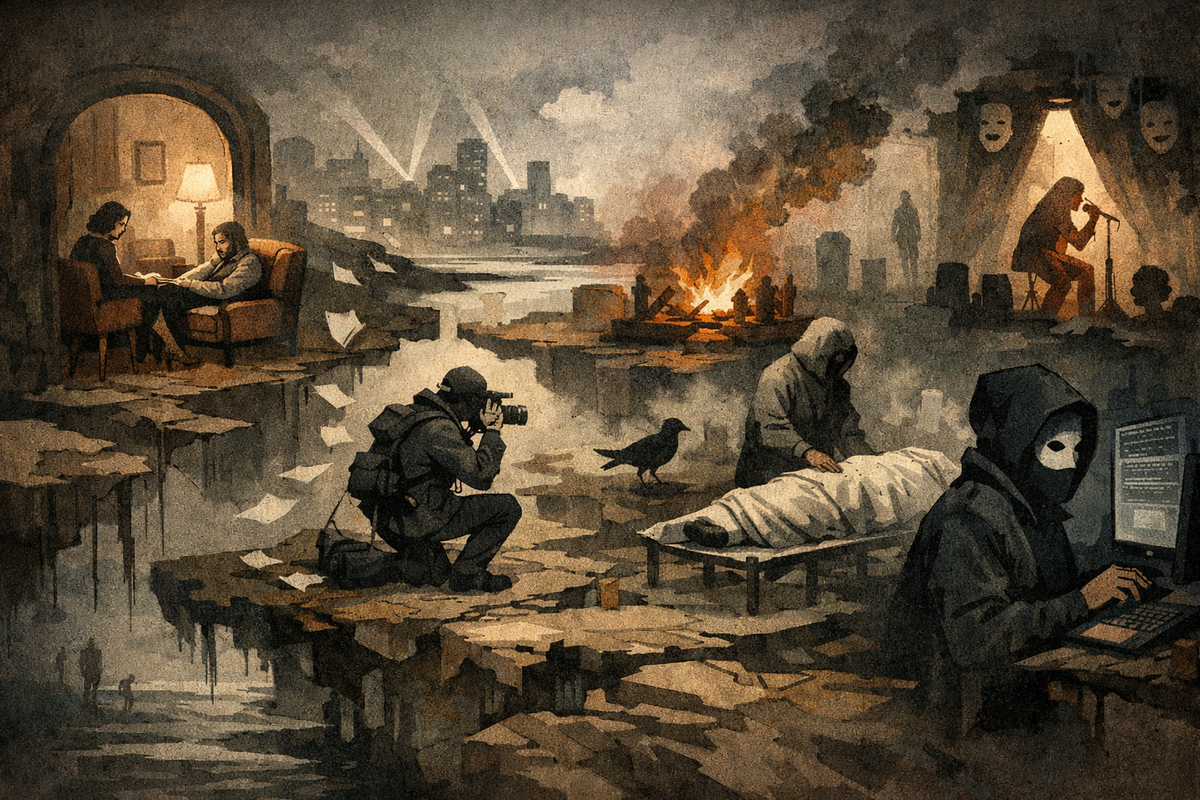
that is what this whole series has been trying to get us to see. the therapist, the comedian, the journalist, the funeral worker, the artist, the anonymous online account, the activist-scholar, the ritual facilitator, the subcultural organizer, the community musician, each carries a shard. modern society likes this arrangement because it allows the center to imagine it no longer depends on any disreputable outer band. the dependency has not vanished. it has merely become harder to name because it is distributed.
distribution solves some old problems. hereditary stigma weakens in some places. caste fixity softens in some places. specialized training can be more widely available. all of that matters. but distribution creates new losses too. the people carrying one fragment are often severed from those carrying the others. institutions do not know how their functions rhyme. public life becomes more procedural and less ritually integrated. the culture keeps needing the old work while losing a language for the whole cluster.
the therapist
the therapist carries part of the old threshold role: dangerous truth, grief, contradiction, confession, the handling of psychic contamination, the naming of what the ordinary self cannot integrate. this is real work, and modernity badly needs it. but the therapist carries it as credentialed service inside a private frame. what used to be publicly or communally metabolized through ritual, performance, and outer-band expertise often now becomes individualized treatment.
the gain is obvious. some people receive care they would never have received otherwise. the loss is also real. the social meaning of suffering thins when every threshold is routed into private appointment culture. the old liminal role often knew that grief, contradiction, and dangerous truth were not only personal burdens. they were public facts needing public form.
the journalist and the archivist
the journalist and the archivist carry modern fragments of memory and truth work. they preserve record, confront power, hold continuity, and make public what institutions would prefer to keep clean. in this sense they inherit something from the Griot and the fool at once. they are necessary and repeatedly punished. they are supposed to stand outside power enough to tell the truth and close enough to power to know what must be said.
modern culture treats these as professional roles rather than liminal ones, but the older structure is still visible under stress. the journalist acquires outsider status exactly when the work begins to function properly. the archivist becomes politically dangerous exactly when memory stops flattering the regime.
the artist and performer
the artist carries catharsis, inversion, public feeling, and a sanctioned zone of excess. the comedian especially inherits the fool’s bargain. if the joke cuts deeply enough, the comedian is accused of impurity, vulgarity, or danger; if the joke does not cut deeply enough, the role empties out into content. the performer lives where art and social truth still scrape against each other.
the problem is that modern capitalism wants the gift while making the carrier precarious. that is an old pattern in new clothes. applause replaces honor. visibility replaces security. the artist still carries liminal heat and is still expected to be grateful for being consumed.
the funeral worker, the sanitation worker, the invisible handler
other fragments remain close to the old material underside. funeral workers, hospice workers, embalmers, sanitation labor, cleaners, people handling waste, contamination, death, bodily aftermath, all continue to carry functions the center depends on while often remaining curiously invisible in the moral imagination of the respectable order. modernity professionalizes them, but professionalization does not automatically produce honor proportionate to necessity. the old contempt survives in a cleaner idiom.
that survival is one reason the series began where it did, at the cremation ground. whatever sophistication the later essays gathered, someone still has to touch what the ordinary order wants to deny.
the anonymous and pseudonymous speaker
the internet essay already argued that masked speech now carries part of the old liminal truth function. here i only want to add that anonymity is not a side case. it is one of the ways modernity recreates distance from consequence when official public identity becomes too tightly managed to let difficult speech move freely. the pseudonymous account is unstable, often ugly, often necessary. again the old pattern returns in distributed form.
what has no shared house now
the deepest loss modernity produces may be that the functions no longer share a house. memory here, grief there, truth somewhere else, catharsis sold back as entertainment, spiritual threshold work fragmented across therapy, religion, art, internet culture, and private experimentation. the old liminal role, for all its cruelty and unfairness, often held several of these together inside one durable symbolic position. the modern world has very few places where such integration is still visible.
that fragmentation is why so much contemporary life feels both hyper-specialized and spiritually stupid. the functions continue. the knowledge that they belong to one another weakens. we treat journalism, comedy, therapy, ritual, music, archive, and grief care as unrelated sectors when in fact they are modern heirs to a once more integrated civilizational necessity.
the final claim
the claim the series has been earning is finally simple enough to say plainly. every complex society generates figures who handle what the society cannot admit it needs. sometimes they are castes. sometimes troupes. sometimes ritual specialists. sometimes fools. sometimes gods. sometimes professions. sometimes anonymous accounts. the forms change. the need does not.
the great modern mistake is to think the need vanished when the old containers were broken. it did not. what vanished was our honesty about what the functions were and who had been carrying them. the liminal caste was never peripheral. it was one of the conditions under which the center could keep imagining itself as center.
the question now is not whether we can return to the old arrangement. we cannot, and much of it should not be wished back. the question is whether we can learn to recognize the functions honestly enough to stop degrading the people and roles still carrying them in fragmented form. that would not restore the old world. it might, however, make the present one a little less stupid about its own dependencies.
that is the most practical conclusion i can offer. if we cannot rebuild the old vessel, we can at least stop pretending the functions are trivial, decorative, or morally suspect when they appear in modern forms. the center still needs its threshold workers. the only real question is whether it will keep paying them in contempt.
if the series has done its job, that question should no longer sound abstract. it should sound embarrassingly current. who is underpaid for carrying public feeling. who is mocked for carrying difficult truth. who is treated as background while touching death, waste, grief, or contamination. who is consumed as spectacle while denied ordinary honor. who is asked to keep memory alive while everyone else calls memory impractical. the answers are all around us. the old figure has not vanished. it has only stopped arriving under one single name.
This is Part 19 of the liminal caste series.
Previous: the internet as the new liminal space | Hub: the liminal caste