
the rajasthan living archive
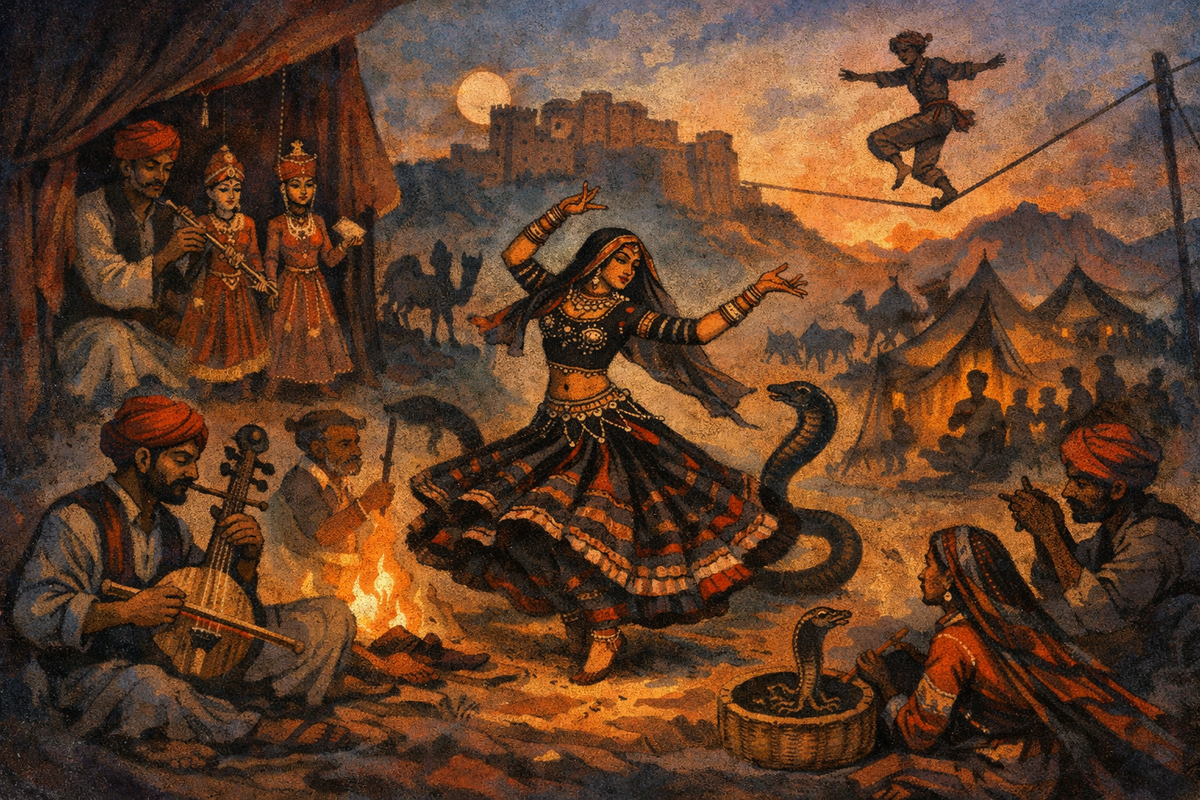
the previous piece made a structural claim. this one needs to put bodies back into it. if the liminal caste is not an abstract category but a recurring social solution, then we should be able to find living traditions that still carry the old repertoire in something close to its original density. Rajasthan is where that density still exists. not in pristine form, not outside modern pressure, not untouched by tourism, law, nationalism, or the usual indignities of being made legible to the modern state; but still recognizably alive. the archive is not only textual. it moves from village to village. it sings at weddings. it dances in skirts stitched with mirrors. it speaks through wooden puppets. it walks ropes and handles snakes and remembers lineages that were old before the british learned how to classify them.
that matters because the westward Dom-Lom-Rom trail, for all its importance, is a fragmented trail. diaspora preserves by breaking and carrying. it brings things forward, but it also shears them loose from the ecosystem that once held them together. Rajasthan still preserves more of that ecosystem. not the Dom alone, and not in a genealogically simple line, but the wider hereditary performance world in which Dom and Dom-adjacent groups operated; musician castes, puppet castes, acrobat castes, nomadic dancer communities, each carrying a specific piece of the same liminal archive. what survives there is not a museum exhibit. it is evidence of what the larger cultural complex looked like before migration, criminalization, and export scattered its pieces across continents.
one caution is necessary before i start naming traditions. i am not claiming that every hereditary performer group in Rajasthan is secretly Dom, or that the Manganiyar and the Langa and the Kalbelia can be collapsed into one caste identity because doing so would make my argument neater. they cannot. they are distinct communities with distinct histories, religions, patronage systems, and social positions. what links them is not identical origin. what links them is structural adjacency. they occupy the same outer band of the social order, they carry hereditary repertoires, and they do forms of memory, performance, mediation, and ritualized threshold work that the settled center consumes without having to generate from its own ranks.
the manganiyar and the langa
the Manganiyar and the Langa are the first place to look because they make the memory argument visible in daylight. both are hereditary musician communities of western Rajasthan. both are Muslim. both have long-standing patronage ties to Hindu Rajput and related landholding families. a single performer may carry devotional material crossing religious lines without experiencing the arrangement as contradiction at all. this is what the modern mind, trained to expect hard identities and clean cultural ownership, reliably fails to understand. the performer does not experience himself as trespassing into someone else’s ritual world. he experiences himself as doing the work his lineage has been trained to do.
the work is not generic music. that is the point. it is wedding repertoire, funeral repertoire, genealogical praise, seasonal songs, local deity songs, Sufi material, Krishna bhajans, region-specific love lyrics, historical ballads. it is an archive distributed across bodies and voices rather than across shelves. a Rajput lineage does not merely hire a musician for atmosphere. it relies on a hereditary outside community to carry the songs and memory by which the lineage recognizes itself in public. the dependence is deep enough that the performer can often remember the patron family more faithfully than the patron family remembers itself.
this is why the Manganiyar and Langa are so important to the series. they demonstrate that memory work and outsider status belong together more often than modern respectability wants to admit. the community whose job is to remember you cannot be fully identical with you, because then it would be vulnerable to the same pressure to edit, flatter, and sanitize. the outside musician can hold the lineage at a slight angle. he can praise it, but he can also preserve it. the arrangement is different in form from the mande Griot system i will get to later, but the underlying mechanism is nearly the same.
the kalbelia
the Kalbelia make a different point. if the Manganiyar preserve memory through patronage, the Kalbelia show what happens when a liminal livelihood is attacked by the modern state and forced to mutate in public. historically associated with snake-handling, snake-charming, itinerant medicine, and related nomadic trades, the Kalbelia occupied a visibly marginal social position even by the standards of the rajasthani performer world. they were not buffered by aristocratic patronage. they lived closer to prohibition, suspicion, and improvisation.
that history matters because the modern Indian state effectively criminalized the traditional male occupation when wildlife laws and anti-snake-charming enforcement made the old livelihood untenable. what survived was the performance form that had grown around the occupation. the dance detached from the snake. the women became the visible carriers of the tradition. the black swirling dress, the serpentine movement, the pungi and dholak accompaniment, the whole embodied vocabulary of the community’s older relationship to the snake moved outward into the global performance economy. the tradition did not vanish. it translated itself.
there is nothing marginal about that mechanism for the purposes of this series. it is central. again and again, when a liminal caste loses the legal right to practice its older occupation, the performance shell hardens into the new livelihood. the ritual residue becomes exportable art. sometimes that saves the tradition. sometimes it hollows it out. usually it does both at once. the Kalbelia survive by making the visible aesthetic of the old life carry what the old life itself can no longer legally hold.
that is one of the crucial lessons Rajasthan offers. the archive is not static. it adapts under pressure. sometimes adaptation means preserving the whole form. sometimes it means preserving only the choreographic skin while the older economic and ritual infrastructure disappears. both outcomes are part of the record. neither should be romanticized.
the kathputli
the Kathputli tradition, historically carried by Bhatt puppeteers, shows the speech function of the liminal caste with unusual clarity. puppet theater is easy for modern audiences to misread as children’s entertainment or folk ornament. in the older social world it was much closer to a licensed machine for public speech. the puppet can say what the direct human speaker cannot say. satire becomes safer when it passes through carved wood and cloth. social contradiction becomes stageable. figures of rank become ridiculous without anyone having to pretend that the puppeteer himself outranks them.
this is not a decorative feature of the art form. it is the art form’s social job. the puppeteer stands in the liminal gap between community and critique. he is near enough to the audience to know what tensions are alive in it, and far enough from the respectable center that he can risk giving those tensions a voice. the puppet becomes a mask that licenses truth. later in the series, when i get to the fool and the trickster more directly, this logic becomes explicit, but it is already here in the rajasthani material. the fool’s license is not invented in europe. it is a recurring solution wherever a society needs contradiction spoken without letting contradiction become open revolt.
the Kathputli archive also matters because of form. puppetry is portable. it travels well. it can move between courts, bazaars, villages, and caravan spaces with less infrastructure than a temple and more mnemonic density than a written pamphlet. that portability matters when we start thinking about what kinds of performer technologies are most likely to survive movement westward or eastward. a carved puppet repertoire is exactly the kind of thing a mobile hereditary group can carry, adapt, and revoice as it crosses social worlds.
the nat
the Nat are the acrobatic edge of the same archive. rope-walking, contortion, trained balance, mobile spectacle; a repertoire requiring long embodied apprenticeship and social conditions under which that apprenticeship can be sustained across generations. the settled center tends to experience this kind of skill as marvel and entertainment. what it does not want to see is the social infrastructure required to produce it. nobody becomes a professional hereditary acrobat by accident. the body has to be raised inside the form. technique has to be passed down. risk has to be normalized. mobility has to be economically workable.
this is one of the reasons the Nat matter for the larger Dom-Lom-Rom argument. when later european audiences encounter traveling acrobats, performers, tinkers, fortune tellers, itinerant musicians, and fairground specialists, they are not encountering unrelated odd jobs that happened to travel together. they are encountering fragments of a much older integrated performer world. Rajasthan lets us see that integration more clearly than the later european record does. the song, the balance act, the puppet, the genealogical praise, the snake, the satire, the ritual threshold work; these belong to one broad outer-band ecology of labor.
what the living archive proves
the real value of the rajasthani material is that it keeps the series from becoming too literary too early. once you start talking about archetypes, structures, and cross-civilizational recurrence, there is always a danger of drifting upward into elegant abstraction and losing the bodies that make the abstraction true. Rajasthan forces the bodies back in. here are actual hereditary communities. here are actual repertoires. here are actual patronage relations, survival strategies, gendered adaptations, religious crossings, and portable performance forms. here is a surviving world in which liminal work is not a metaphor but a profession.
what that world suggests is that the source complex behind the Dom trail was larger than any single caste label can hold. it included memory work, praise work, music, puppetry, acrobatics, itinerant entertainment, threshold ritual, and forms of licensed speech. some branches of that complex moved west and became part of the Roma archive. some moved east through other circuits. some remained where they were and changed shape under local pressure while keeping the old logic. Rajasthan is valuable because it preserves enough of the whole ecology to let us infer the missing pieces elsewhere with more discipline than pure speculation would allow.
it also lets us say something i do not want the later cost-accounting essays to obscure. the liminal archive was never only a story of victimhood. it was a working civilizational competence. these communities carried real technique. real memory. real forms of social and ritual intelligence. the stigma attached to the people carrying the archive was brutal, and i am not trying to soften that. i am trying to keep us from confusing social degradation with cultural emptiness. the center degraded them partly because the center depended on capacities it could not comfortably acknowledge.
the next essay follows one branch of that larger performer world out of Rajasthan and into movement: the silk road as transmission belt. if this piece shows the archive still clustered close to home, the next one asks what happens when the same kinds of portable forms, puppetry, acrobatics, music, itinerant performance, start moving through central asian exchange zones where whole cultures meet and misrecognize one another in transit.
This is Part 3 of the liminal caste series.
Previous: the untouchable as spiritual specialist | Hub: the liminal caste | Next: the silk road as transmission belt