
the silk road as transmission belt
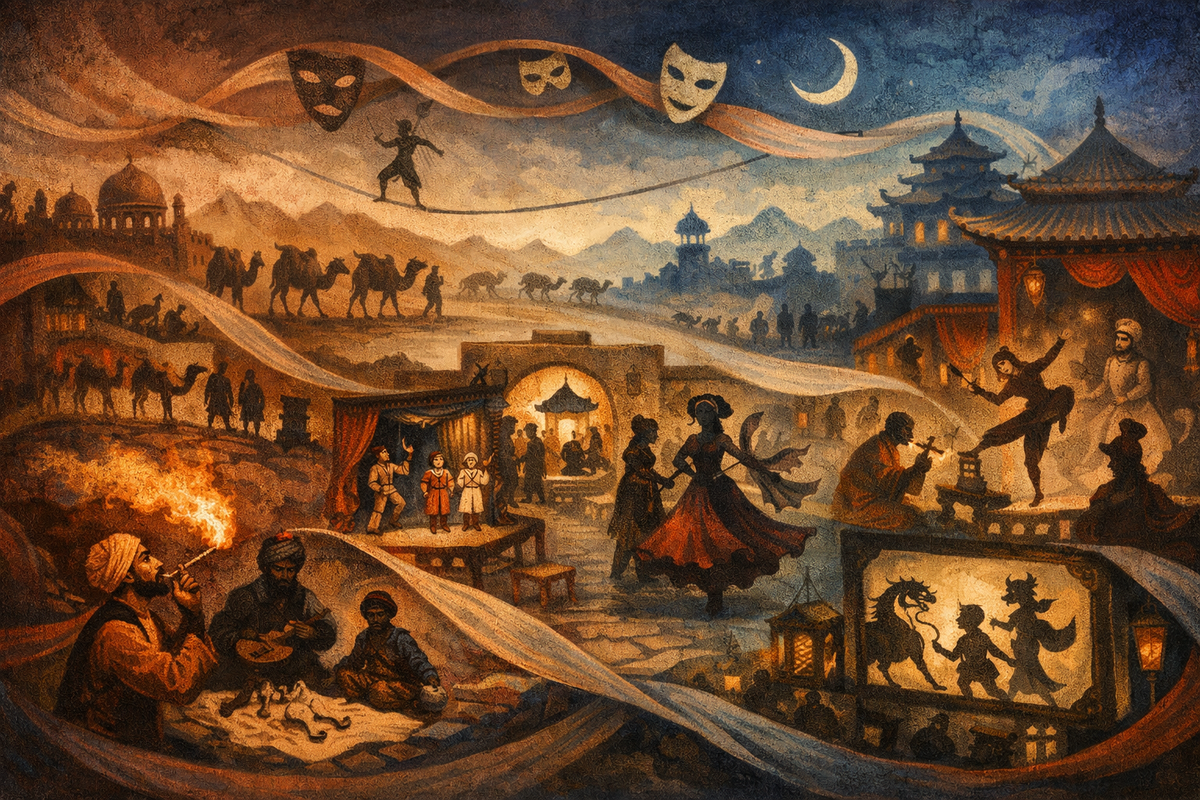
the rajasthan piece stayed close to home on purpose. before following any of this material outward, i wanted the density of the source world in view. otherwise the later movement starts to look like disconnected curiosities: a puppet form here, a dance there, an acrobat somewhere else, and a modern reader gets to pretend that history is just a series of charming accidents. it is not. the performer world that clustered so densely in western india was mobile by design. some of its carriers moved west along the trail that eventually becomes the Roma archive. some of its forms and adjacent practices moved east and north through the silk road contact zones, where merchant routes, court cultures, pilgrimage circuits, and itinerant entertainers kept crossing one another for centuries.
this essay needs to be careful in a way the previous two did not. the westward Dom-Lom-Rom line can be tracked with linguistic confidence. the eastward story is murkier. what we have is not one clean diaspora narrative with a neat family tree attached. what we have is a zone of transmission. the silk road is best understood here not as a single line of descent but as a belt of repeated contact in which portable performance forms, acrobatics, puppetry, music, divination, itinerant spectacle, moved alongside goods, stories, and religious ideas. the direct documentary trail is thinner. the structural argument is still strong.
the key question is not whether one can prove that a single caste community from Rajasthan marched in one direction and became every later eastern performance tradition. one cannot, and i do not want to fake that confidence. the key question is whether the silk road world had the conditions required for liminal performer forms to travel, hybridize, and settle into new local systems. it plainly did. caravan routes need entertainment. courts need foreign marvels. mixed trading populations need people who can perform across language barriers. mobile religious worlds need ritual specialists and diviners. a portable hereditary craft world from india enters that ecology and immediately finds more than one use.
who carried the route
the Sogdians matter here, not because they were the only carriers, but because they were the most famous merchant intermediaries of the overland route between roughly the fourth and ninth centuries CE. from Samarkand and Bukhara outward through the Tarim basin and into Tang China, Sogdian traders built colonies, family networks, and translation zones dense enough that historians often describe Sogdian as one of the working languages of the silk road. they moved silk, silver, paper, animals, stories, religious texts, and people. once you have a merchant diaspora operating at that scale, you also have a system that can carry performers, instruments, costumes, tricks, and narrative forms whether or not the merchants themselves are the performers.
the reason i want the Sogdians in the frame is structural. they occupy, at the scale of interregional trade, something like the same position the liminal caste occupies inside a stratified society. not identical, but analogous. they live between worlds. they speak across categories. they profit from what fixed populations cannot do for themselves. they are indispensable and mistrusted in exactly the proportions one would expect of a people whose livelihood depends on crossing boundaries other people spend their time policing. once that kind of intermediating class exists, it creates lanes down which more obviously liminal figures can travel.
that includes entertainers. the road is not just a commercial pipe. it is a social world in motion. caravans stop. merchants gather. courts import novelty. pilgrims need lodging. soldiers get bored. cities want spectacles from elsewhere. all of this creates demand for the kinds of portable arts hereditary performer communities are unusually good at sustaining. you do not need to claim a total migration to see the mechanism. you need only see that a mobile performance archive entering a world organized around repeated cross-cultural contact will travel more easily than a locally fixed ritual form ever could.
why performance travels so well
some things move badly through multilingual contact zones. doctrinal subtleties move badly. legal systems move badly. land-based forms of prestige move badly. portable performance moves extremely well. an acrobatic feat needs almost no translation. a puppet show can be revoiced in the local idiom while preserving its mechanics. a melody can be borrowed faster than a theology can. a divinatory gesture, a costume, a dance turn, an instrument technique, these travel because they can be learned in fragments and attached to new local meanings without losing all continuity with the old ones.
this is one reason the liminal archive keeps showing up in trade worlds. the people carrying it work in the most exportable media available before print and broadcast. bodies. sound. masks. puppets. rhythm. portable marvel. all of these can pass between cultures at speeds that ordinary village institutions cannot match. the performer is, by profession, already adapted to audiences who do not fully belong to his world. he knows how to hold attention across difference. he knows how to turn partial comprehension into an advantage.
the silk road rewards exactly that skill set. a market town or caravan stop with five languages in the air has limited use for a discourse of fine doctrinal precision. it has enormous use for music, rhythmic display, manipulated figures, comic inversion, trained animals, fortune telling, and staged wonder. these are not peripheral amusements. they are some of the oldest shared technologies for producing temporary coherence among strangers.
the caravanserai as liminal stage
the caravanserai is usually described as an inn, which is true in the same way calling a port city a parking lot for boats is true. yes, people and animals stopped there. yes, goods were stored. but a caravanserai was also a threshold machine. traders from different worlds slept in one enclosure. translators, guards, mendicants, brokers, pilgrims, and entertainers all worked the same perimeter. a place like that generates its own demand for liminal labor. someone has to negotiate. someone has to amuse. someone has to interpret signs, read moods, stage trust, relieve tension, and turn an overnight assemblage of strangers into something less combustible than it might otherwise be.
that is where the performer world enters. not as decoration around trade, but as part of the social infrastructure that made trade livable. the acrobat and puppeteer and musician do not merely entertain after business has concluded. they help produce the temporary public the trade world requires. the social body of the silk road is not a nation or a village. it is an unstable mixed crowd, and unstable mixed crowds have always needed specialists in rhythm, spectacle, satire, trance, and narrativized wonder.
once you see the caravanserai this way, the eastern movement of the liminal archive becomes easier to think about without overclaiming. i do not need to prove a direct line from one Rajasthani troupe to one central asian inn. i need only see that the overland trade world created an unusually favorable environment for exactly the forms the rajasthani performer ecology specialized in. portable arts do not survive by accident. they survive because the route keeps rewarding them.
courts, exotica, and misrecognition
the second major site of transmission is the court. Tang China is the obvious example because the textual record is richer there than it is in many of the spaces between, but the dynamic is broader. courts like foreign spectacle. they like it partly because it is beautiful and partly because it confirms the court’s own centrality; all the world, or so the court imagines, is arriving here to perform for power. dancers from central asia, musicians carrying mixed repertoires, acrobatic forms of uncertain origin, exoticized costumes, translated stories, these all enter courtly consumption under the sign of marvel.
what the court almost never understands is the social world out of which the marvel came. a hereditary performance form arrives and gets read as exotic surface. the caste ecology behind it, the outer-band status that produced the expertise, the long apprenticeship, the stigmatized or mobile community that carried it, all of that drops away. the host power wants the art without the social truth of the art’s origin. this is the same move the series keeps watching in other settings. the center loves the gift and erases the conditions under which the gift was made.
that is one reason i am resisting a too-neat eastward genealogy. misrecognition is part of the evidence. by the time a form arrives in a court record, it has often already been renamed by the people consuming it. something from india becomes central asian in a chinese text. something from a hereditary performer world becomes simply “foreign entertainment.” the trail is real, but the categories in which the settled archive records the trail are not the categories the performers themselves would have used.
eastward movement without the fantasy of total proof
so what can be said honestly. portable performance forms associated with hereditary liminal communities in india were well suited to silk road movement. central asian merchant and court networks created sustained demand for such forms. surviving textual and art-historical evidence from the broader silk road world shows repeated circulation of music, dance, puppetry, acrobatics, and other spectacle forms across exactly these corridors. later east and southeast asian traditions preserve some of the functions this series is tracking, performer as mediator, performer as truth-teller, performer as ritual specialist, in ways that make transmission and structural convergence both plausible parts of the story.
what cannot be said with the same confidence is that every later eastern case is simply Rajasthan transplanted. some are parallel developments. some are mixtures. some are local systems that absorbed traveling forms into pre-existing ritual worlds. transmission does not eliminate local invention. it complicates it.
for the purposes of this series, that complication is enough. the silk road essay does not need to prove ownership. it needs to establish movement, contact, and the special suitability of liminal performance for trade routes built out of mixed publics and recurring threshold spaces. once that is clear, the rest of part two can do its work. the Burakumin show independent convergence. the Namsadang show another mobile performer solution. wayang shows what happens when the performer becomes an explicit mediator between visible and invisible worlds. the european carnival essay will show the western side of the same larger problem.
the silk road, then, is best understood as a transmission belt in the literal sense. not a final destination, not a single lineage, not a proof machine; a moving apparatus through which forms traveled, collided, shed context, acquired new context, and kept going. what survived the movement was not purity of origin. what survived was function.
This is Part 4 of the liminal caste series.
Previous: the rajasthan living archive | Hub: the liminal caste | Next: the griot: west africa’s version