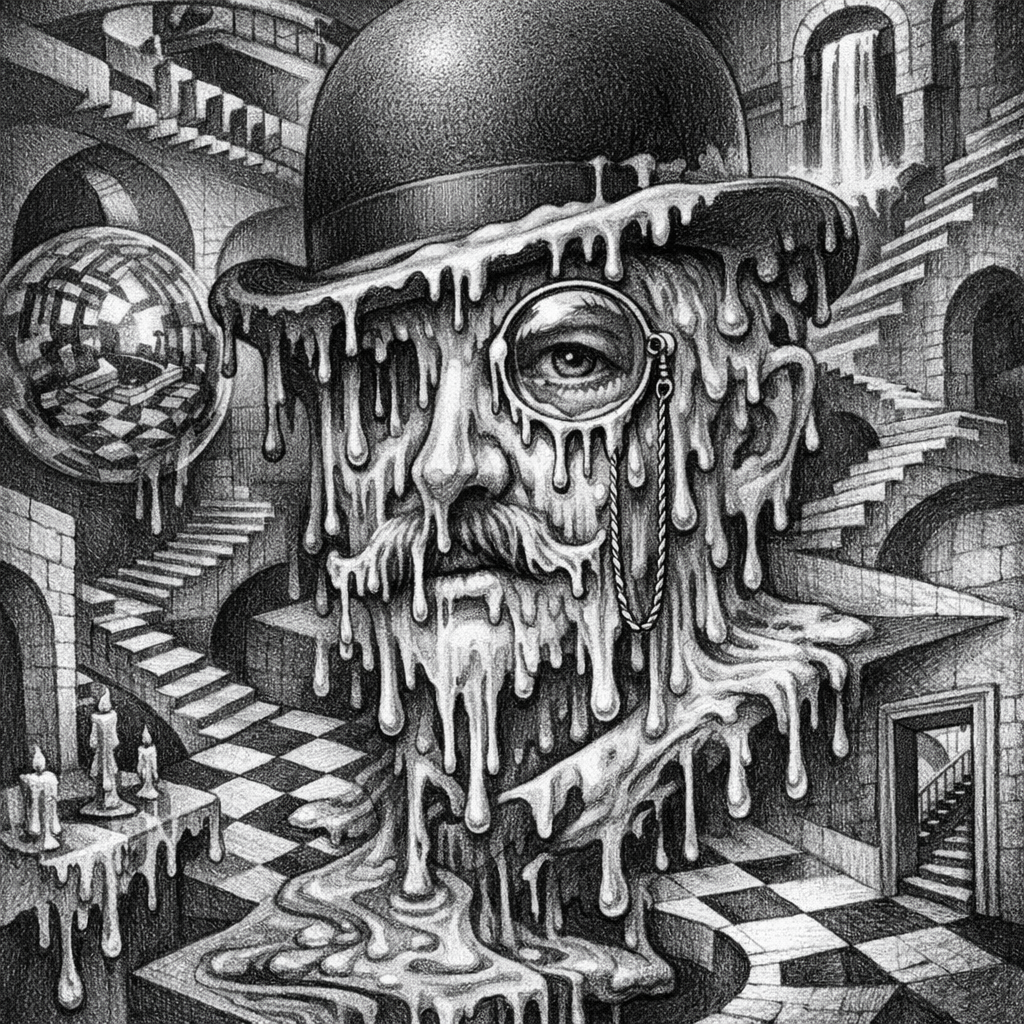
the untouchable as spiritual specialist
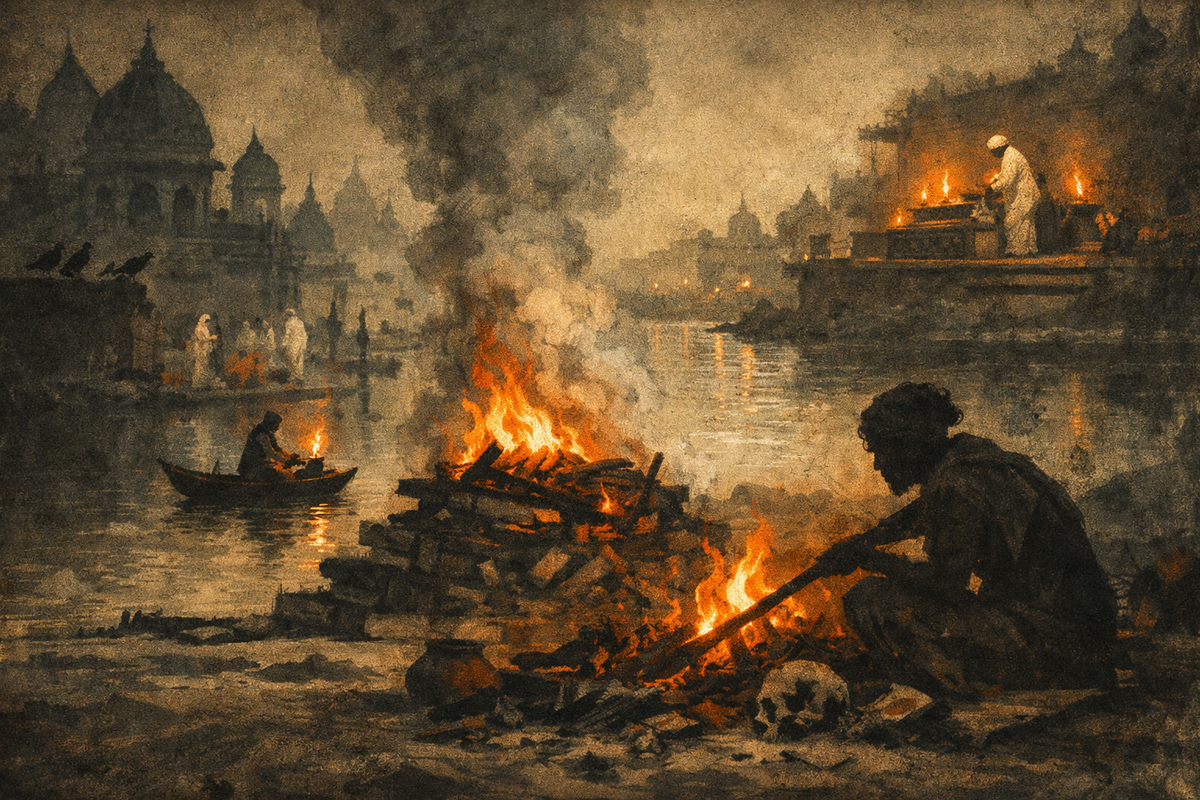
the first piece in this series ended at the cremation ground for a reason. if you want to see the whole logic of the liminal caste in one image, that is the image. a sacred city. a holy river. a pyre burning at the threshold between the living and the dead. and the person whose hands keep the whole ritual world operational is the person the ritual world has declared unclean. the contradiction is not incidental. the contradiction is the structure. the society needs someone to do the work that its own purity system cannot admit into its center, so it produces a figure who is both excluded from the center and indispensable to it. once you see that clearly, the Dom stop looking like an oddity of indian caste and start looking like the first fully legible version of a pattern that recurs almost everywhere.
the thinker who made this legible for me, and who is load-bearing for the whole middle of this series, is Mary Douglas. Purity and Danger, published in 1966, is one of those books that permanently damages your ability to accept a civilization’s categories at face value. Douglas’s claim, in its simplest form, is that dirt is not a natural category. dirt is matter out of place. pollution is what a classificatory system calls the thing that crosses its lines. a corpse is not dirty because there is some metaphysical grime attached to it. a corpse is dangerous because it is a person who is no longer a person in the ordinary social sense, and any society built on stable categories is forced to react when something it depends on slips between the categories it uses to keep the world orderly. that reaction is what we call ritual pollution.
once you follow Douglas one step further, the whole architecture changes shape. what is treated as polluted is often structurally identical to what is treated as sacred. both are set apart. both require special handling. both demand ritual expertise. both sit too close to the unstable edge where a society’s categories stop holding. the priest at the altar and the worker at the cremation ground look like opposites only because the society needs them to look that way. in structural terms they are standing on the same seam. one handles the dangerous excess from the honored side. the other handles it from the dishonored side. the seam does not care which costume the society has chosen to drape over the role.
what Douglas actually saw
Douglas was writing against two bad habits in anthropology at once. one was the habit of treating purity codes as primitive superstition, decorative irrationality layered on top of otherwise practical life. the other was the habit of flattening every taboo into disguised hygiene. she argued, correctly i think, that both explanations miss the point. purity systems are classifications before they are anything else. they are the way a society says: this belongs here, that belongs there, these two things must not be mixed, this boundary is real. once you understand that, taboo stops looking irrational. it starts looking like a culture defending the categories that make its world intelligible to itself.
her most famous examples come from Leviticus, where certain animals are forbidden not because they are biologically toxic but because they scramble the scheme of classification the text is working with. creatures in the sea should have fins and scales. creatures on land should fit the expected pattern of hoof and cud. the animal that blurs the pattern is the animal marked as unclean. the logic is not nutritional. it is taxonomic. pollution is the name given to anomaly when anomaly threatens order.
that part of Douglas’s argument is now famous enough that even people who have not read the book have absorbed some version of it. the stronger move, the one this series needs, is what happens next. no society can avoid anomaly. you cannot build a civilization that never encounters death, blood, decomposition, menstruation, childbirth, ecstasy, madness, carnival, prophecy, or the destabilizing fact that people change status and cross thresholds all the time. so the society does the only thing it can do. it appoints specialists. it produces rituals. it creates social locations for the people who will handle what the ordinary social world cannot touch without threatening its own coherence.
the specialists who emerge in that space are never ordinary figures. they are marked. sometimes they are elevated, clothed in sanctity, separated from common life by honor. sometimes they are degraded, treated as untouchable, separated from common life by stigma. but the separation itself is the constant.
the cremation ground and the altar
this is why the Dom matter so much to the argument of the series. the burning ghat is not only a place of disposal. it is a ritual machine for managing one of the most dangerous thresholds any social order has to face. someone has to tend the fire, move the body, handle the remains, work at the point where person, object, ancestor, pollution, and sanctity all collapse into one another. the orthodox purity system cannot place one of its own central figures there without destabilizing itself. so the work is displaced outward. the person who does it is designated outside.
but outside is not the same thing as irrelevant. it is much closer to the opposite. the Dom worker at the cremation ground knows something the purified center cannot know, because the purified center has defined itself in part by staying away from the knowledge in question. expertise accumulates where contact accumulates. the brahmin can speak the theology of death; the Dom knows the operational reality of it. the brahmin can narrate purity; the Dom can keep the whole apparatus from collapsing when a body actually arrives.
the phrase untouchable tends to encourage moral simplification. it sounds as though the society merely despises the person and pushes them away. that certainly happens, and the cost is real, but it is not the whole story. the untouchable is not just rejected. the untouchable is assigned. the exclusion is a functional decision inside the taxonomy. the society is saying: this work must happen, this work threatens the categories we need, therefore the people who do it must become a category of their own. once that category exists, the usual horrors follow. hereditary stigma. inherited poverty. violence rationalized as order. but the category begins as a solution to a structural problem, not as an arbitrary burst of cruelty.
this matters because it explains why the same shape keeps appearing in societies that did not borrow the institution from one another. the Japanese case, which i will take up in the Burakumin piece, is not indian caste exported east. it is an independent system converging on the same answer: put the handlers of death, blood, leather, butchery, and certain forms of performance outside the ordinary status order, then let the whole society pretend the outside is accidental rather than necessary.
why exclusion produces expertise
the second step in the argument is harder for modern egalitarian language to say out loud, but the series cannot work if i avoid it. exclusion does not only produce suffering. it also produces specialization. the people a society pushes to the edge often become the people with the most developed knowledge of whatever the society has pushed there. that is not a justification for the exclusion. it is the mechanism by which the arrangement persists across centuries.
if a population is assigned death work for generations, that population will accumulate techniques, rituals, tacit knowledge, emotional calibration, and symbolic authority around death that no abstract theory can replicate. if a population is assigned memory work, as the Griot are in west africa, it will accumulate forms of genealogical and historical intelligence that cannot be improvised by a bureaucrat stepping into the role. if a population is assigned the work of performance at the threshold between satire and ritual, as so many hereditary performer groups are, it will develop a level of embodied craft that the respectable center can later copy only in fragments.
the knowledge accumulates precisely because the center is not willing to pay the price of accumulating it itself. the center wants the function without the contamination that the function implies. so it offloads both the labor and the cost. what comes back from the margin is not only labor but culture: songs, rites, expertise, techniques of truth-telling, ways of staging danger so that the rest of the society can encounter it without being destroyed by it.
this is why the liminal caste so often ends up carrying spiritual authority from the wrong side of the social map. the authority is real. it is simply inconvenient to the official picture of where authority is supposed to live. the Dom Raja handling the sacred flame at Manikarnika is one form of this. the Griot holding the true genealogy of a noble lineage is another. the puppeteer who can criticize power through the mask, the fool who can tell the king the truth, the fortune teller who can say aloud what the respectable citizen already fears; these are all variations on the same arrangement. exclusion makes the speech possible because exclusion releases the speaker from certain obligations of conformity. stigma and freedom arrive braided together.
pollution and the sacred are the same category
when i say the polluted and the sacred are the same category, i do not mean they feel the same in lived experience. being revered is not the same as being shunned. honor and degradation are not interchangeable human outcomes. what i mean is that both are social technologies for handling what cannot be treated as ordinary. both mark a person or substance as carrying a dangerous charge. both organize special rules around contact. both say, in effect, ordinary life cannot absorb this directly.
you can see the same structure in many religious vocabularies. Hebrew tumah, Japanese kegare, Greek miasma; different traditions, same underlying problem. something has crossed a line. something is too close to death, blood, transformation, or divine force. the thing must be managed, and the person who manages it becomes marked by the management. sometimes that mark becomes prestige. sometimes it becomes stigma. often, over time, it becomes both.
modern secular societies flatter themselves that they have moved beyond this logic. mostly they have just bureaucratized it. the funeral industry, the psych ward, the prison, the sanitation system, the therapist’s office, the intensive care unit, the performance venue; these are cleaner, more professionalized containers for liminal work, but they are still containers. someone still has to do the work that lets the ordinary world imagine itself as untouched by death, madness, waste, conflict, and the need for ritualized release. the main thing that has changed is that the specialization is no longer always hereditary or explicitly named as sacred pollution.
what this changes in the way we read the series
once Douglas is in place, the rest of the series stops being a tour of colorful outcastes and becomes a single argument with many local expressions. the Manganiyar are a memory-bearing outside caste. the Griot are custodians of truth whose reliability depends on their distance from the ruling class. the Burakumin are a society rediscovering the same solution to the same problem. the carnival fool, the puppeteer, the wayang dalang, the Namsadang performer, the Romani musician, the trickster deity itself; all of them belong to the same field of social necessity.
this also changes the moral temperature of the claim i am making. if the liminal caste were merely an exploited residue, the story would be tragic but conceptually simple. the problem is that the liminal caste is more than residue. it is generative. it holds capacities the center does not know how to produce on its own.
none of this softens the cost. i want to keep saying that because there is a cheap version of this argument waiting to be made, and i have no interest in making it. the fact that a society needs the untouchable does not redeem the cruelty of untouchability. the fact that the margin becomes culturally generative does not justify the violence that keeps people there. what it does do is explain why the violence is not enough to eliminate the role. erase one carrier and another appears. criminalize one tradition and fragments of it surface elsewhere. the function survives the disgrace because the function is load-bearing.
the next piece turns away from theory and back toward living material. Rajasthan still contains hereditary performance communities that preserve, in active form, a great deal of the wider cultural complex out of which the westward Dom-Lom-Rom trail emerged. if this essay is the conceptual hinge, the next one is the evidentiary body laid open on the table. the archive is not dead. it is still singing.
This is Part 2 of the liminal caste series.
Previous: the dom: where it begins | Hub: the liminal caste | Next: the rajasthan living archive