
the griot: west africa's version
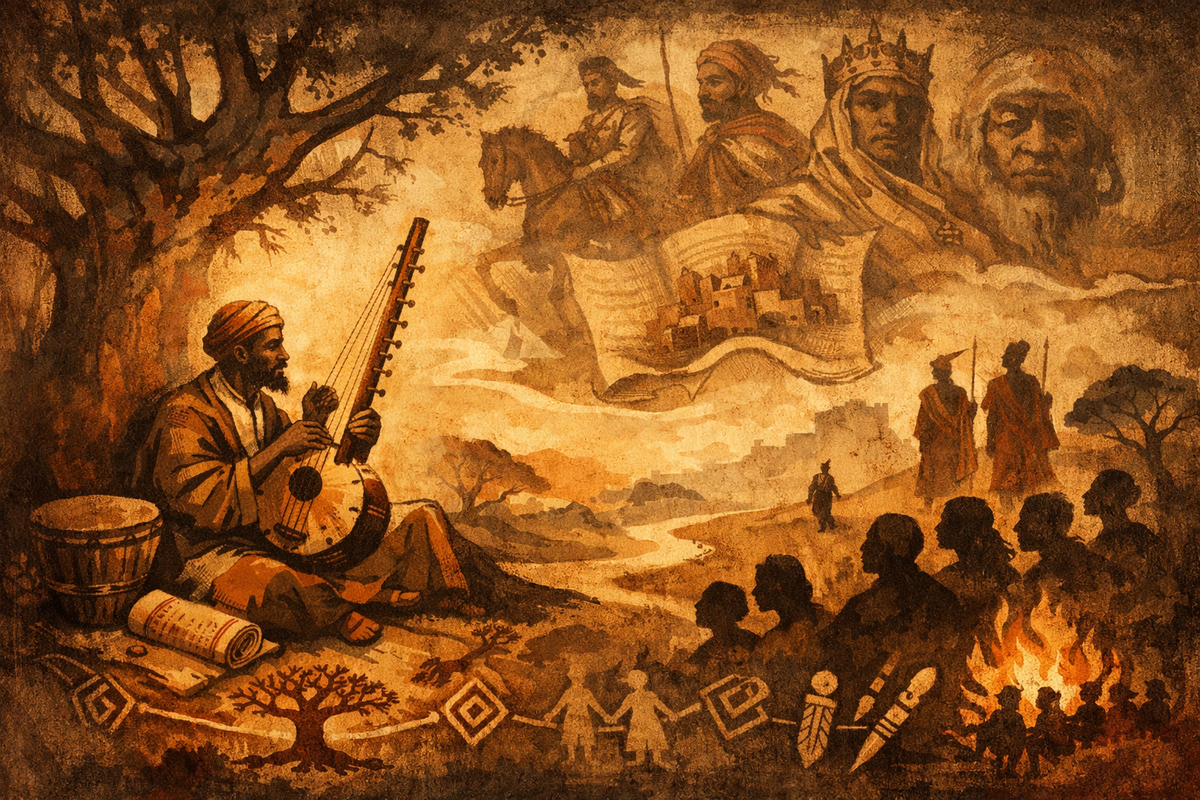
the most important thing about the Griot, for the purposes of this series, is that the Griot is not indian. i want to say that early because otherwise the temptation is to make every later case an extension of the Dom trail and call the work finished. that would be lazy and wrong. the Dom trail is the longest documented line of the liminal caste pattern. it is not the only source from which the pattern can arise. west africa gives us something more useful than a duplicate. it gives us an independent solution to the same structural problem. a society needs memory, praise, mediation, music, and a licensed form of truth-telling that does not sit fully inside the ruling class. so it produces a hereditary outside group to hold them.
that group, in the mande world, is the jeli, the figure european languages flattened into griot. once you stop hearing that word as decorative folklore and start hearing it as a professional title, a great deal becomes clear very quickly. the jeli is not a charming remnant of pre-literate culture. the jeli is a specialist. historian, genealogist, praise singer, negotiator, musician, custodian of founding epics, keeper of dangerous memory. and, crucially, the specialist stands at a slight angle to the noble class whose history he preserves. the angle is what makes the role work.
the previous essays have already been building toward this. the Dom show the relation between pollution and sacred function. Rajasthan shows hereditary performer communities carrying memory and portable cultural technique from the outer band of the social order. the Griot adds another indispensable element: reliable public memory depends on not being fully owned by the people whose reputation the memory contains. if the ruling class keeps its own record without outside custodians, its record becomes flattery at speed.
who the griot is
the colonial term griot covers several related hereditary speaking and musical roles across west africa, especially in mande-speaking societies. the internal term most often used in the literature is jeli or jali, depending on language and transliteration. the point is not to fetishize terminology but to recover function. this is a hereditary profession. one is born into it. one trains into it. one inherits repertoire, obligation, style, patronage relations, and a specific social location that is neither reducible to nobility nor collapsible into ordinary commoner life.
the jeli belongs to a wider world of specialist groups in mande society, and that wider world matters because it makes the analogy to the liminal caste stronger, not weaker. the jeli is not merely a singer with a good memory. the role exists inside an organized social logic in which certain families carry specific kinds of transformative skill across generations. music, speech, mediation, praise, remembered lineage, the binding of public occasions through performance; these are not hobbies. they are inherited civic technologies.
that language may sound grandiose until you ask what happens when such a role is absent. what happens is that weddings lose their binders, disputes lose one of their negotiable voices, noble houses lose their living genealogy, rulers lose a witness who can praise them without becoming them, and the founding story of the polity drifts into whatever version current power finds most flattering. the jeli is one of the mechanisms by which memory stays public rather than becoming private property.
it is also worth being explicit about what this is not. it is not a pre-literate improvisation surviving until modernity finally teaches the society how to write. that is the standard colonial misunderstanding, and it says more about the misunderstanding than about the role. literate traditions and hereditary memory specialists can coexist because they are solving different problems. a text can preserve a record. the jeli can animate it in public, tie it to living obligation, and deliver it inside a social form power is willing to hear.
memory from the outside
this is the core of the essay. the Griot’s memory is trustworthy not because it is disinterested in some modern bureaucratic sense, but because its position is oblique. the jeli depends on patrons, yes, but does not merge into them. that distance matters. if the noble house could fully absorb the memory-holder into itself, then genealogy would become branding and epic would become court press release. the point of the hereditary memory caste is that it holds continuity across the rise and fall of specific patrons.
that continuity is professional as much as moral. a jeli’s authority depends on being recognized as someone who carries the repertoire and the record in a way other people can test against their own knowledge of the tradition. he is not simply inventing on command. the performance can praise, heighten, interpret, and rhetorically intensify, but it cannot become arbitrary without destroying the very asset for which patrons seek it. the noble house wants glorification, of course it does; but it also wants legitimacy, and legitimacy depends on a memory public enough to be believed.
this is why the role belongs in the series. a hereditary outside group becomes indispensable precisely because it can do for the center what the center cannot safely do for itself. that is the same mechanism we have already seen elsewhere. the center needs the function but cannot host the function at full intensity without distorting it. so it pushes the role outward, then relies on what the outward role produces.
the Griot is not outside in the same way the Dom are outside. i do not want to flatten all varieties of marginality into one texture. the social valence is different. the relation to pollution is different. the prestige pattern is different. but the structural logic is recognizably adjacent. a society needs a class of specialists who can hold what ordinary rank order cannot hold directly. there is the family resemblance.
what the griot says that others cannot
the other thing the Griot carries is licensed speech. this is where music, praise, criticism, and mediation stop being separate categories and become one profession. the jeli can celebrate a lineage, remind it of its obligations, embarrass it by recalling what it has failed to live up to, and intervene in conflict without pretending to be just another subject in the hierarchy. the role has permission to speak because the role is socially marked as different.
that permission is one of the oldest functions in the whole liminal archive. the fool has it. the puppeteer has it. the satirist at festival time has it. the fortune teller has it in another key. the Griot has it through praise and memory. the center hears truth more easily when truth arrives wrapped in role, rhythm, and inherited license. naked contradiction invites retaliation. licensed contradiction can be metabolized.
this is one reason the modern world is often worse at truth than the older one, not better. we imagine that procedural neutrality is enough. often it is not. people hear what they can hear. societies absorb self-knowledge through forms that lower the cost of receiving it. a hereditary speaking caste is one such form. again, not morally pure, not utopian, not cost-free; but real.
epic, genealogy, and the making of a public
the epic tradition makes the same point from another angle. a founding story like Sunjata is not important only because it preserves information about a political beginning. it is important because it gives a dispersed population a repeatable form in which to hear itself as a people. the Griot does not simply remember the founder. he stages the founder into the present tense every time the epic is performed. the past becomes audible as a claim on current conduct. this lineage came from somewhere. this house owes something to what it says it descends from. this ruler is not floating free from history.
that is why genealogy and performance belong together in the role. a written list of names can record descent. it cannot, by itself, make descent socially alive. the Griot can. the spoken line, the musical phrase, the praise name, the gathered audience, all of it turns record into public event. memory becomes binding because it is encountered together. that is a different civic technology from the archive, not an inferior one.
it also explains why the role survives transitions that should, in theory, have made it obsolete. literacy does not kill it. state formation does not kill it. recording technology does not kill it. all of those things change the environment, but they do not eliminate the need for a socially authorized figure who can make the past present in a form that moves bodies and reputations at the same time. information can be stored anywhere. legitimate memory still has to be staged.
music as social technology
the modern west encounters the Griot first through music because music is the part most easily exported. the kora player on a world-music stage, the virtuoso with astonishing technique, the recorded beauty of the line, this is real and deserves admiration. but if we leave the role there, we misread it in exactly the way courts and modern cultural markets so often misread liminal labor. we take the beautiful output and strip away the social apparatus that made it meaningful.
the instruments matter because they are not detachable from the role. kora, ngoni, bala; these are not merely sounds but vehicles for inherited repertoires and occasions. marriages, praise performances, recitations, historical narrations, negotiations, political theatre disguised as celebration; the music works because it arrives inside a matrix of social understanding. the performer is not just playing well. he is doing memory in rhythm.
that phrase matters to me because it makes the broader argument visible. memory is not only archival content. it is a way of binding a public. the Griot does not preserve the past by storing it in silence. he preserves it by reperforming it in forms people can receive together. what gets remembered is inseparable from how it is staged. this is why so many liminal castes are performance castes. performance is one of the oldest technologies for making social knowledge stick.
it is also one of the oldest technologies for making hierarchy tolerable without making it disappear. a song can praise a patron and remind the patron of his debts in the same movement. a recitation can thicken dignity and expose fragility at once. that doubleness is not ornamental. it is part of the profession’s genius.
this is why i resist the modern urge to split aesthetics from social work. when we do that, we congratulate ourselves on loving the art while proving that we have ceased to understand what the art was for. the Griot is not simply a musician who happened to inherit some stories. the Griot is a role in which music became one of the mechanisms by which a society remembered itself aloud.
an independent proof of the pattern
if the series had only the Dom and their descendants, a skeptical reader could still say: fine, this is one regional history with an unusually long afterlife. the Griot makes that dismissal harder. here is a separate civilizational world, different languages, different religious layering, different political structures, different caste logics, arriving at a hereditary specialist role that handles memory, mediation, praise, music, and difficult truth from a position slightly outside the ruling order. the details are not identical because the societies are not identical. the recurrence is the point.
the recurrence also sharpens the claim i am moving toward in the middle essays. the liminal caste is not only the group that gets stuck with dirty work. it is the group that holds capacities complex societies repeatedly externalize and then repeatedly depend on. memory is one. licensed speech is one. embodied public feeling is one. ritualized social glue is one. once you see the Griot in that frame, the role stops looking peripheral and starts looking load-bearing.
none of this removes the hierarchy or the cost. dependency is not justice. being needed is not the same thing as being free. but the Griot case makes it impossible to pretend that marginal or outer-band roles are merely leftover social debris. very often they are the place where a society stores the functions it is least capable of acknowledging in itself.
that is why the role stays socially edged even when it is culturally central. if it were absorbed completely upward, it would lose the obliqueness that makes its speech usable. if it were pushed wholly outside the social body, it would lose the authority that makes its memory binding. the Griot remains in that tense middle because the middle is the instrument. prestige without distance would ruin the function. distance without prestige would ruin it too.
the next essay turns to Japan, where the same broad structural problem produces a different arrangement again. the Burakumin case matters because it shows convergence without inheritance. the social machine discovers the same answer in another language.
This is Part 5 of the liminal caste series.
Previous: the silk road as transmission belt | Hub: the liminal caste | Next: the burakumin: japan’s parallel development