the namsadang: korea's traveling players
if the Burakumin piece showed the heavy underside of the liminal archive, the Namsadang bring us back to movement, spectacle, and the peculiar freedom that only a socially edged performer troupe can hold. they matter because they make the traveling version of the pattern unmistakable. here is a group whose work is acrobatics, music, puppetry, satire, bodily risk, and public festivity; a troupe passing from village to village, socially low enough to be treated as suspect and structurally necessary enough to be remembered everywhere they went. the settled order does not fully want them. the settled order also keeps calling for them.
that is the first thing to keep in view. the Namsadang are not simply entertainers wandering through premodern Korea because there happened to be a market for diversion. they are a social solution. agrarian, status-conscious, morally policed societies need moments in which hierarchy loosens without actually dissolving. they need occasions where criticism can arrive masked as laughter, where bodily virtuosity can suspend ordinary rank for an hour, where the village can gather around something excessive enough to break the routine without breaking the social world outright. a traveling performance troupe from the outer band of the order is one way of producing exactly that.
the second thing to keep in view is that the Korean case, like the Japanese and mande cases, is not useful because it is identical to the indian one. it is useful because it is different and still structurally legible. the Namsadang were not a cremation caste. they were not keepers of genealogy in the mande sense. what they carried was a mobile bundle of public functions: comic inversion, puppet speech, acrobatic wonder, music, and carnivalesque permission. the bundle changes from civilization to civilization. the social angle from which it is carried does not change nearly as much.
the troupe at the edge
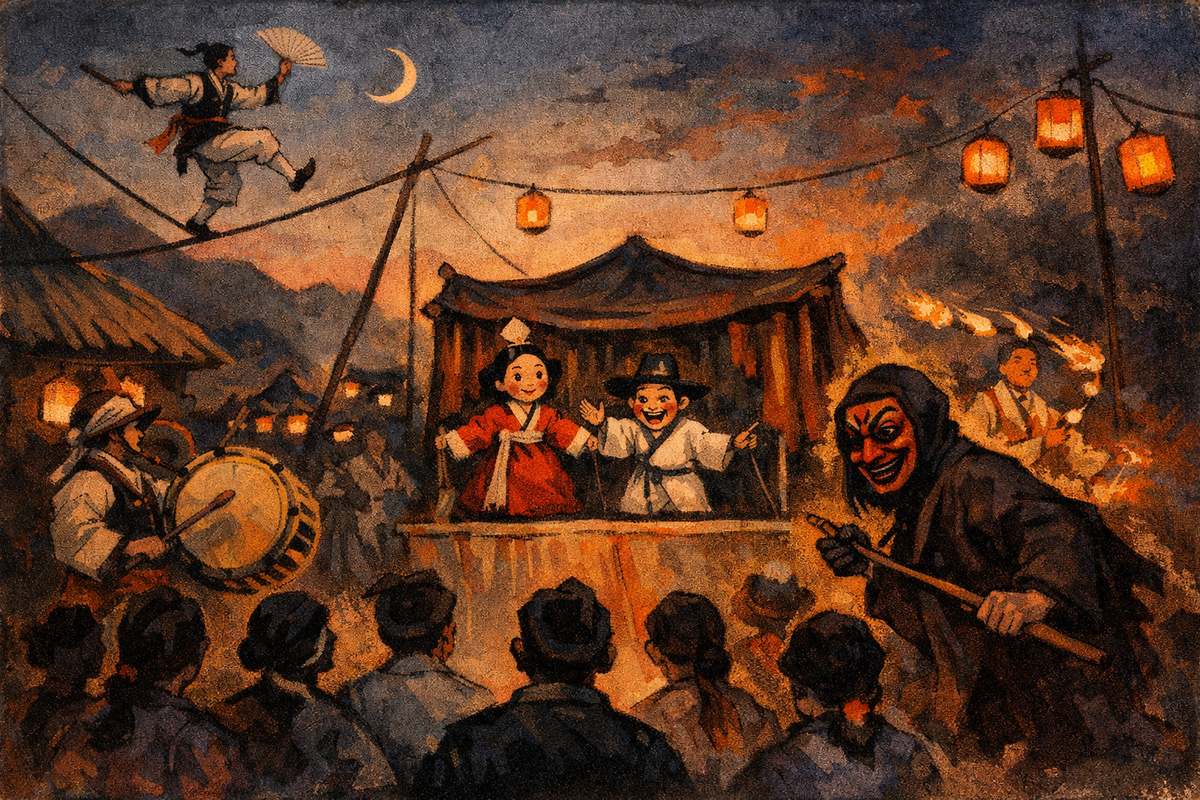
the Namsadang were historically an itinerant all-male performance troupe associated with low status and social marginality, moving through markets, villages, festival grounds, and public gathering places across the korean peninsula. that much is clear enough in the standard descriptions. the details of origin and exact social classification are more textured than a quick modern summary usually admits, and i do not want to flatten them into one neat formula, but the broad picture is stable. this was a troupe world of people who lived by motion, bodily skill, performance, and the ability to assemble a temporary public wherever they arrived.
motion matters here. settled status orders dislike mobility because mobility makes people hard to classify and harder to govern. a farmer tied to land is readable. a lineage tied to district is readable. a moving troupe carrying masks, instruments, puppets, ropes, jokes, and rumor is much less readable. so the moving troupe attracts two different reactions at once. fascination, because it brings novelty, pleasure, and the outside world into view; and suspicion, because it is not anchored where the respectable center thinks proper persons should be anchored.
that double reaction is one of the signatures of the liminal role. the Namsadang are wanted precisely because they arrive from somewhere else, because they carry bodily and social permissions the local order cannot generate from its own respectable face. but the same fact that makes them useful also keeps them edged. they belong to festival time more than to household time. they are licensed to appear, not fully absorbed.
acrobatics, masks, and public permission
what traveled with the troupe was not one art but a package. acrobatics, tightrope performance, music, comic play, mask material, and puppetry all belong together because they solve adjacent problems. the acrobat suspends ordinary bodily expectation. the mask loosens ordinary social identity. the comic performer permits speech no one else in the village can quite risk. the puppet says the thing that direct speech cannot say without consequence. the musicians bind the whole event so that it can be received as occasion rather than as disorder.
this is what i keep wanting the series to notice whenever it reaches performers. the arts are not sitting side by side by accident. they are cooperating around a social function. they produce temporary permission. a village that will not tolerate open contradiction every day can tolerate it when it comes by road, under costume, in rhythm, under the protection of genre. people can laugh at the high through a puppet or a mask in ways they cannot if the same sentence is simply spoken naked in the square.
that is why the Namsadang belong in the same family as the puppeteer in Rajasthan and the fool in europe. the techniques differ. the mechanism does not. the truth needs a carrier who can stand at an angle to the settled order, and performance gives that carrier a shield. laughter is the shield. virtuosity is the shield. costume is the shield. itinerancy itself is the shield, because a troupe that can move on tomorrow can risk a degree of speech a fixed villager may not survive.
kkoktu gaksi and the puppet’s license
the puppet material matters especially because it makes the logic visible in wood. the korean puppet tradition associated with the Namsadang world, often named through kkoktu gaksi play in modern description, belongs to the oldest branch of the liminal archive this series keeps finding: the puppet as licensed contradiction. once the criticism is placed in the mouth of a figure manipulated in public, ordinary prohibitions loosen. the puppet can ridicule rank, stage sexual farce, mock pretension, and make social tensions visible because the speech has been displaced into a figure that is and is not a person.
that displacement is not a trivial theatrical trick. it is a political technology. it allows a community to hear itself think without forcing any one respectable member of the community to own the thought directly. this is the same reason puppet traditions turn up so often near outer-band performer groups. the puppet is a device for routing truth around ordinary consequence.
what matters to me in the korean case is that the puppet is not isolated from the rest of the troupe. it belongs to the larger package of traveling permission. acrobatic danger, comic inversion, musical gathering, and puppet speech all reinforce one another. by the time the puppet speaks, the public has already been moved into a different social register. people are ready to hear things they would refuse in another frame. that readiness is what the troupe produces.
colonial interruption and modern survival
the modern history matters because the Namsadang world did not pass untouched into the twentieth century as a quaint relic waiting to be preserved by heritage committees. japanese colonial rule, modernization, urbanization, and the changing entertainment economy all altered the conditions that had made the itinerant troupe legible. once rail, bureaucracy, police power, commercial theatre, mass media, and later national folklore regimes enter the picture, the old moving world has to either harden into preservable art or thin out into fragments.
this is one of modernity’s standard moves with liminal labor. first it destabilizes the living conditions that made the form possible. then, if the form is lucky, it saves selected pieces as cultural heritage after the social ecology that sustained them has been largely broken. what is preserved is real, and worth preserving, but it is not the same thing as the older world in which the troupe arrived as necessary social infrastructure. heritage is often what remains when function has been partly replaced by display.
that does not make survival unreal. it makes survival double. a tradition can persist as art while losing some of the social permissions that once made it politically and ritually potent. the Namsadang are valuable to the series because they let us see that doubleness very clearly. the form survives. the older mobile edge-world out of which it drew force is harder to recover.
what the korean case adds
the korean case adds mobility back into the argument at full strength. the Burakumin case had already shown that a society can create an outer band around dangerous labor and then carry the stigma forward even after formal abolition. the Namsadang show another variation. the outer band can be moving rather than territorially fixed. it can be organized around performance more than disposal. it can carry criticism, festivity, wonder, and social release rather than death work in the narrow sense. but the structural role is still recognizable: society places needed but dangerous permissions in bodies it will not fully absorb.
it also clarifies why part two of the series has to include so many performer groups before turning to the more abstract middle essays. if i jumped too early to theory, a reader could still imagine that performers are decorative edge cases and that the real argument is about caste in the narrow sense. the Namsadang make that impossible. they show that the liminal role is not confined to one occupational substance. what matters is the social work: public permission, embodied excess, licensed contradiction, moving spectacle, the temporary loosening of hierarchy by people whose own status remains permanently insecure.
that insecurity is not incidental to the gift. the troupe can do what it does because it is not fully pinned to one village’s obligations. it is free in the exact measure that it is precarious. that is the bargain again. the freedom and the stigma are the same thing seen from opposite sides.
the korean case is also useful because it shows how little the word entertainment explains. once the troupe enters a village, it is not merely filling spare time. it is redistributing attention. farmers, children, petty officials, women carrying ordinary domestic burdens, men whose rank matters too much in everyday life; all of them are briefly rearranged around one common field of spectacle. that rearrangement is already social work. people who do not ordinarily share one register of feeling are made to share one for a night.
the settled order depends on that temporary common field more than it can easily admit. ordinary village life produces segmentation. age, sex, class, status, obligation, debt. the troupe arrives and creates a form in which those lines loosen without disappearing entirely. not revolution. not equality. something smaller and more manageable than that, but still necessary: a shared interval of collective feeling. that is exactly the sort of gift liminal specialists keep bringing from outside the respectable middle.
there is also a reason these troupes are so often remembered with a haze of danger around them. they threaten imitation. the child watching does not only receive amusement. the child learns that the body can be trained into other possibilities, that rank can be mocked, that voices can be worn and discarded, that movement across space can produce another kind of life. most children will still grow into the ordinary order. the point is that for a night the inevitability of the ordinary order is broken. the troupe makes alternative human arrangements briefly imaginable.
that imaginative breach is part of the civic function too. without it, hierarchy hardens into destiny. with it, hierarchy remains what it always was: a managed arrangement requiring periodic loosening lest it become spiritually unbearable. the Namsadang are one of the old Korean technologies for producing that loosening in public.
the next essay moves to indonesia, where the performer becomes more explicitly a mediator between visible and invisible worlds. if the Namsadang show the troupe as traveling social permission, wayang shows the liminal specialist as cosmological operator. the puppet remains. the ontology thickens.
This is Part 7 of the liminal caste series.
Previous: the burakumin: japan’s parallel development | Hub: the liminal caste | Next: wayang and the spirit world