
the european convergence: roma meets carnival
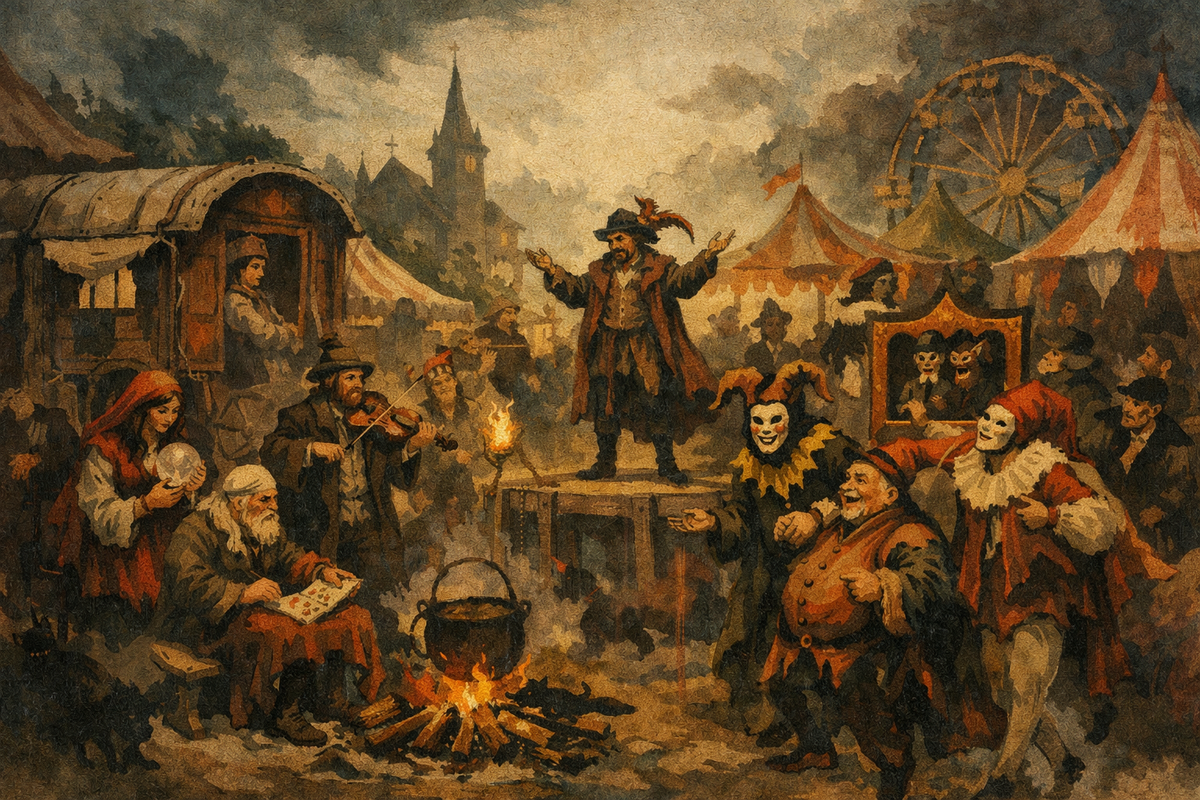
by the time the Dom trail reaches europe, it does not arrive in an empty field. that is the mistake a bad diffusion story keeps making. it imagines the Roma entering a blank continent and single-handedly inventing the performer, the charlatan, the fool, the fairground body, the itinerant wonder-worker, the licensed mocker of rank. europe already had its own carnivalesque machinery. feast days, market fairs, fools, mummers, inversion rituals, traveling sellers of cures and spectacle, church-tolerated intervals in which rank could be mocked without being abolished. what matters is not simple origin. what matters is convergence. one portable liminal archive meets another. the result is explosive.
that convergence is one of the reasons the european case is so useful. it lets us see the liminal role not as the property of one people but as a zone in which several traditions can recognize one another functionally even when they do not recognize one another politely. the church hates carnival and preserves it. settled europe stigmatizes the Roma and hires them. the city wants order and keeps opening fairground space. the ruler requires seriousness and still needs the fool. once you stop reading these as isolated contradictions, they begin to look like one social system telling the truth about itself under protest.
the european archive is especially rich in protest language because europe is unusually skilled at moralizing the functions it cannot stop consuming. that is why the essay has to hold two things together. anti-Roma persecution is real and central. so is the fact that the same societies doing the persecution kept absorbing Roma and Roma-adjacent performer forms into the public life of fairs, festivals, music, divination, and spectacle. exploitation and dependence are not two stories here. they are one.
carnival as licensed inversion
the first half of the convergence is carnival itself. before it becomes a loose adjective for chaos, carnival is a social technology. feast before fasting. meat before abstinence. inversion before discipline. the low mock the high, bodies spill over their ordinary boundaries, ridicule is permitted, excess is concentrated into time so that the rest of the year can return to order having bled off some of its pressure. this is not marginal to the social order. it is one of the order’s relief valves.
the church and the civic authorities never fully like this valve. they tolerate it, police it, prune it, sermonize against it, and use it anyway. that ambivalence matters because it is the same ambivalence the series keeps finding around liminal specialists. the center cannot quite admit that inversion is necessary, so it stages inversion under limited terms and then rushes to declare normality restored once the ritual window closes.
once you have that machinery in place, the traveling performer enters a world already prepared to use him. the fool, the masked comic, the market entertainer, the medicine seller, the acrobat, the manipulator of animal or body or rumor, these do not need to invent their social permission from scratch. europe has built partial lanes for them. what the meeting with the Roma archive does is thicken those lanes, diversify the repertoires, and give the settled order new material to consume while sharpening the stigma attached to the carriers.
the roma enter the fairground world
the Roma arrive in european records as foreigners, suspects, marvels, nuisances, musicians, smiths, fortune tellers, itinerants, and legal problems. those categories are not random. they are the host society’s vocabulary for encountering a people whose occupational cluster already overlaps uncannily with the functions europe had partly externalized into carnival and fairground culture. metalwork, performance, music, mobility, divination, horse dealing, bodily display, portable entertainment; the fit is not perfect but it is close enough that convergence becomes inevitable.
what follows is not a clean adoption but a long contact zone in which european publics repeatedly consume the gift while degrading the giver. the fairground and market town become the obvious spaces for that contact because they already gather mixed populations under looser norms. in a fair, one can buy, gawk, gamble, laugh, hear music, be deceived, be healed, be swindled, and hear truths too sharp for ordinary village speech. the liminal archive thrives there because the fair itself is a temporary suspension of settled clarity.
this is one reason the Roma become so central to europe’s fantasy life. they can be turned into signs for danger, freedom, excess, erotic threat, song, craft, criminality, truth, and theatricality all at once because they are occupying a zone europe itself has not made up its mind about. the Roma are persecuted partly because they reveal that the settled order requires moving outsiders more than it wants to say.
the mountebank, the charlatan, the fool
the italian mountebank and charlatan belong here because they show the same structure emerging in a more locally european vocabulary. the traveling seller of remedies, patter, comedy, and spectacle stands on a platform, gathers a crowd, blends truth and fraud, diagnosis and theatre, medicine and performance. modern respectability reads this as primitive quackery on the road to proper medicine. that is too simple. the mountebank is one of the old liminal specialists of the market public. he is a truth-teller and deceiver in the same body because the public wants both. it wants cure, marvel, narrative, and relief from official speech.
the fool belongs here for the same reason. the fool is not only a comic ornament at court. he is a controlled leak in the truth regime of power. because he is marked as licensed absurdity, he can say what flatterers cannot and ministers dare not. he is close enough to the king to matter and low enough for his speech to be survivable. that same structural position keeps appearing in the market, at festival time, in puppet booths, in satirical performance, and in the voices societies designate as ridiculous so they can hear them without immediately having to obey them.
when i say europe converges, this is what i mean. the Roma do not invent the fool. catholic carnival does not invent the moving performer caste. the fairground does not invent licensed speech. but all of them meet in spaces where the same cluster of functions begins reinforcing itself: inversion, bodily excess, satire, divination, spectacle, dangerous charm, public release. convergence is not sameness. it is mutual amplification.
persecution as disavowed dependence
the european case would be easier to write and much worse to think with if persecution and dependence could be cleanly separated. they cannot. anti-Roma law is not a side note to the convergence. it is part of it. expulsion, criminalization, surveillance, forced settlement, stereotype, police harassment, and later the vast catastrophe culminating in the Porajmos all belong to the same civilizational relation that keeps drawing on Roma music, labor, and liminal charisma. a society does not persecute this intensely what it regards as merely irrelevant.
that is the point i want held firmly here. persecution often marks disavowed dependence. the host society sees in the outsider something it needs and something it does not want to admit needing. mobility is one such thing. musical vitality is one such thing. divinatory ambiguity is one such thing. the public stage on which truth and fraud mix under the sign of spectacle is one such thing. europe punishes the Roma for carrying too much of what europe itself has placed at the edge of its own order.
once you see that, the old images start clarifying. the wagon, the fiddle, the fairground, the fortune teller, the camp at the edge of town, the fool’s cap, the carnival mask, the charlatan’s platform; all of them belong to a field of social necessity that the settled order keeps trying to rename as mere disorder. but the repetition gives the lie away. what recurs that reliably is not an accident. it is load-bearing.
what the european case proves
the european convergence proves that liminal systems can layer rather than merely repeat. a civilization can already possess its own carnival machinery and still absorb another people’s performer archive into that machinery. once that happens, origin becomes less important than function. who can gather the crowd. who can risk the joke. who can sell the cure and the story together. who can carry music across classes. who can appear as suspect and indispensable at once. the answers begin to overlap.
it also proves that the center’s official morality is a terrible guide to what the center actually needs. christian europe preached order and required carnival. it criminalized Roma mobility and repeatedly fed on Roma-adjacent forms of performance. it despised charlatanry and could not stop assembling beneath the charlatan’s stage. hypocrisy is too weak a word. this is structural dependency spoken in the grammar of condemnation.
that matters because the next block of essays needs exactly this evidence. once the case studies are on the table, the middle of the series can finally stop circling and say what the liminal caste actually gives: memory, catharsis, truth, boundary management, and a way for a society to encounter dangerous contents without being broken open by them all at once. europe, with all its contempt, kept taking the gift. that is why the convergence matters.
europe also gives the series a particularly sharp lesson in the politics of naming. once the outsider is renamed vagabond, gypsy, charlatan, mountebank, rogue, fairground type, low entertainer, the function becomes easier to trivialize and the carrier easier to police. but the repetition of these names across centuries is not proof that the figures were all interchangeable scoundrels. it is proof that the settled order kept meeting the same cluster of moving functions and reaching for contempt as its preferred vocabulary of management.
that contempt has had an unusually long shelf life because europe exported so much of its own archive to the rest of the world. later readers inherit the stereotype before they inherit the structural understanding. they learn to see the fairground as kitsch, the fool as ornament, the Roma as menace or romance, and only much later, if at all, notice that an entire continent repeatedly built zones in which dangerous truth, bodily excess, and controlled social inversion could be carried only by figures it insisted on keeping socially suspect.
the european case, then, is not important because it is uniquely evil or uniquely carnivalesque. it is important because it shows with painful clarity how a civilization can document its dependency in enormous detail and still narrate that dependency as marginal spectacle. one can read the whole record and still miss the simplest fact if one wants to miss it badly enough. the low figures were not beside the european order. they were among the things that made the order livable.
the next essay turns from cases to mechanism. after this many civilizations, the repetition is no longer anecdotal. it is time to say directly what the liminal caste gives and why societies keep generating the figure even when they spend centuries trying to degrade, erase, or absorb it.
This is Part 9 of the liminal caste series.
Previous: wayang and the spirit world | Hub: the liminal caste | Next: the essential gift: what the liminal caste actually gives