
the burakumin: japan's parallel development
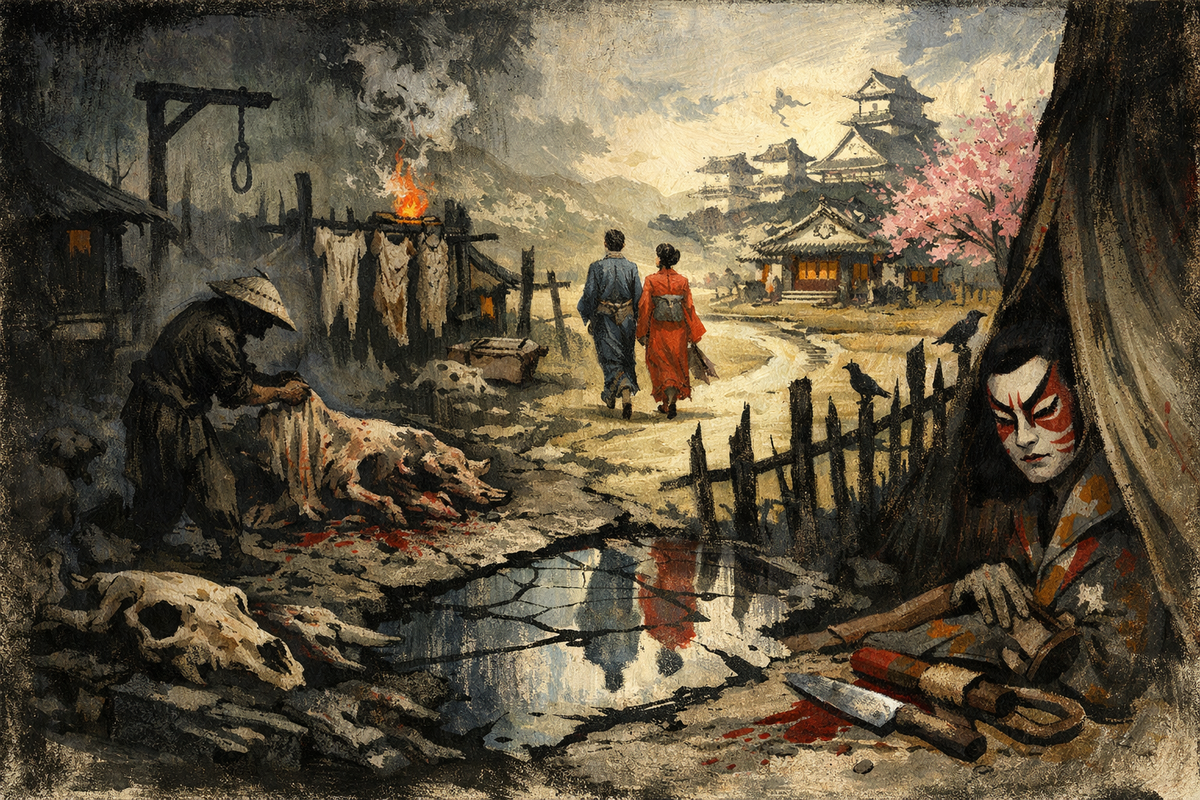
the Burakumin matter because they make it impossible to keep treating the liminal caste as an indian peculiarity with some long diaspora afterlife. here is another society, formed under entirely different religious and political conditions, discovering a recognizably similar answer to a recognizably similar problem. death work, butchery, leather, execution, disposal, certain kinds of performance, labor too necessary to do without and too contaminating to leave in the clean middle of the social map; the result is a bounded outcaste population, legally marked, socially stigmatized, and functionally indispensable. the details are japanese. the structure is not.
that is the first reason this case matters. the second is that the Japanese example gives us one of the clearest views of what happens when a society tries to modernize the visible form of the hierarchy without actually relinquishing the social logic underneath it. the old legal categories are abolished, the vocabulary changes, the modern nation-state announces itself cleaner than the feudal order that preceded it, and yet the stigma persists through address, family registry, rumor, marriage screening, and a thousand small technologies of remembered exclusion. the Burakumin case is not only a parallel development. it is one of the best records we have of how a liminal caste survives its own official disappearance.
before i go any further, i want to avoid one flattening move that would make the essay easier to write and worse to read. the Burakumin are not simply “Japan’s untouchables” in some one-to-one comparative sense. the historical categories, the local cosmology of pollution, the role of the state, and the specific genealogy of the outcaste communities differ from the indian case. comparison is useful here only if it remains structural. what is parallel is not every texture of life. what is parallel is the social solution: put the handlers of dangerous thresholds on the outer band, then teach the center to treat dependence on that band as shameful evidence rather than as part of the civilization’s own design.
pollution in japanese form
the key word in the japanese case is kegare, usually translated as pollution or defilement, though like most such words it carries more than any single english equivalent can hold. death, blood, butchery, execution, and animal carcasses belong to a field of contamination the respectable center wants managed without having to identify too closely with the people who manage it. once that logic is active, the hereditary assignment of occupation becomes socially sticky very quickly. the group doing the work becomes not just occupationally distinct but morally read through the work.
that pattern hardened historically into statuses conventionally glossed in english through the old categories eta and hinin, terms modern usage handles carefully because they are inseparable from stigma and state classification. what matters for the argument here is that these were not random insults drifting through village life. they were categories with legal and administrative force. the outer band in this case was not merely cultural. it was formalized. the Tokugawa order, like many rigidly stratified systems, preferred visible classification because visible classification turns dependency into governance.
this is one of the places where the Burakumin case sharpens the series. in some earlier examples the outer-band position is obvious socially but more diffuse institutionally. in Japan it becomes easier to watch the state participate in making the edge durable. certain communities become associated with carcass disposal, leather work, execution, and related forms of labor. once that happens, the occupational function and the social reading of the people carrying it begin feeding each other. the work marks the people. the marked people are then assigned the work more firmly. stigma becomes self-reproducing not because it is natural, but because the social machine has found a stable loop.
necessary work, disavowed dependency
the Japanese case also makes the central paradox unusually hard to miss. no feudal order can function without leather, disposal, slaughter, punishment, and the whole material underside of ritual cleanliness. horses need tack. armies need equipment. towns produce waste. bodies die. animals die. law is enforced. all of this requires handling, and much of the handling takes place in zones the respectable center insists on naming as contaminating. what the center cannot bear is not the existence of the work but the thought that the work belongs to it.
so, as elsewhere, the work is displaced outward and then morally reread as evidence about the people to whom it has been assigned. this is the move i keep wanting readers to notice. the outcaste is not discovered as already polluted and then given dirty work because the person fits it. the outcaste is produced by the social need to locate necessary contaminating work somewhere. only after the assignment settles into place does the society begin telling itself stories about the people who do it as though their essence explained the arrangement.
once those stories harden, the consequences become severe. endogamy, segregated settlement, inherited stigma, violence, and restrictions around marriage and status all follow. but the point i need this piece to keep alive is that the moral story comes after the structural need, not before it. the Burakumin are a parallel development because Japan rediscovers the same way of refusing ownership of indispensable labor.
the performance edge
the writer CSV is right to flag performance here, but this is exactly the sort of area where sloppy comparative writing starts inventing certainty it has not earned. so i want to say this carefully. the Burakumin case is tied most clearly and securely to death work, leather, butchery, disposal, and related occupations. the relation to performance is real, but more uneven in the record and easier to overstate if one is not disciplined. what i think can be said with confidence is that several performer worlds in premodern Japan sat close to the same outer band in which stigma, bodily display, mobility, and licensed marginality were already being organized.
that matters because performance is very often one of the places a society lets the edge re-enter under controlled conditions. the person whose ordinary social standing is bounded can still appear in festive, theatrical, or carnivalesque space as a carrier of energy the center wants but cannot generate from its official face. this is one reason the kabuki connection keeps attracting attention. kabuki emerges historically from a messy field of marginal bodies, licensed spectacle, pleasure districts, itinerant and public performance, and social zones the respectable order both condemns and consumes. i do not want to claim a single clean line from Burakumin communities to kabuki as though the whole art form can be assigned to one hereditary source. that would be too neat. i do think the broader point stands. the same society that outwardly polices polluted margins keeps drawing theatrical vitality from those margins.
the structure should sound familiar by now. stigma and generativity turn out not to be opposites. the edge becomes productive because it is forced to hold forms of bodily knowledge, danger, and social permission the center cannot comfortably host. performance enters not in spite of the outer-band position but often because of it.
abolition without disappearance
the modern part of the Burakumin story is one of the most important in the whole series. in 1871, during the Meiji period, the formal status distinctions were legally abolished in what is usually called the Emancipation Edict. on paper this looks like the clean modern answer. the old categories disappear. all subjects become equally legible to the new state. feudal pollution gives way to national citizenship.
in practice, almost nothing that mattered socially vanished on command. communities remained legible through place. family records remained searchable. marriage investigators and employers found ways to screen for origin. stigma that had once been openly legal became unofficial, which in some ways only made it harder to confront because the modern state could now deny that the hierarchy still existed while the hierarchy continued to structure life. this is the move modernity keeps making with liminal castes. it abolishes the visible vessel and leaves the social memory intact.
that persistence matters because it shows how much of the hierarchy had always lived in ordinary social reflex rather than in law alone. once a district is known, once a surname pattern is watched, once families begin quietly asking where another family comes from before agreeing to marriage, the outer band can survive in softened form indefinitely. the language becomes more polite. the exclusion does not necessarily become less real. if anything, denial can make it more durable by removing the official object that would otherwise have to be named and fought.
the Burakumin liberation movement exists because of that persistence. what had supposedly been solved by law required political struggle, documentation, confrontation, and organized refusal. this matters for the larger argument because it shows that liminal-caste structures are not dissolved merely by moral embarrassment. if the social machine still needs an edge and still remembers who used to occupy it, the official fiction of equality will not be enough to rewrite the arrangement.
what the japanese case proves
the japanese case proves three things the series needs. first, that the liminal-caste pattern is not dependent on indian transmission. second, that the pattern can be formalized very clearly by the state and still feel, from the inside, natural to the society reproducing it. third, that modern abolition does not necessarily abolish the underlying logic. it may simply drive the logic deeper into registry, marriage, rumor, and polite denial.
it also helps us refine the whole argument. the liminal caste is not one kind of marginality. it is a family of arrangements in which dangerous threshold labor, public necessity, and social disavowal are bundled together and then projected onto a bounded population. sometimes performance is central. sometimes death work is central. sometimes memory and truth-speaking are central. often several are braided together. the braid changes. the outer-band mechanism does not.
this is why the Burakumin belong here so centrally. they let us watch a society generate a structurally familiar edge without help from the Dom trail, and then watch that edge survive the transition into modern national life. if the earlier essays show how civilizations create liminal specialists, this one shows how hard they are to get rid of once created, even when the official ideology insists they are already gone.
the next piece turns to Korea and the Namsadang, where mobility and performance come back into the foreground. the Burakumin case is the heavy material underside of the archive. the Namsadang piece returns us to itinerant players, puppetry, and the socially indispensable troupe that lives at a traveling angle to the settled order.
This is Part 6 of the liminal caste series.
Previous: the griot: west africa’s version | Hub: the liminal caste | Next: the namsadang: korea’s traveling players