wayang and the spirit world
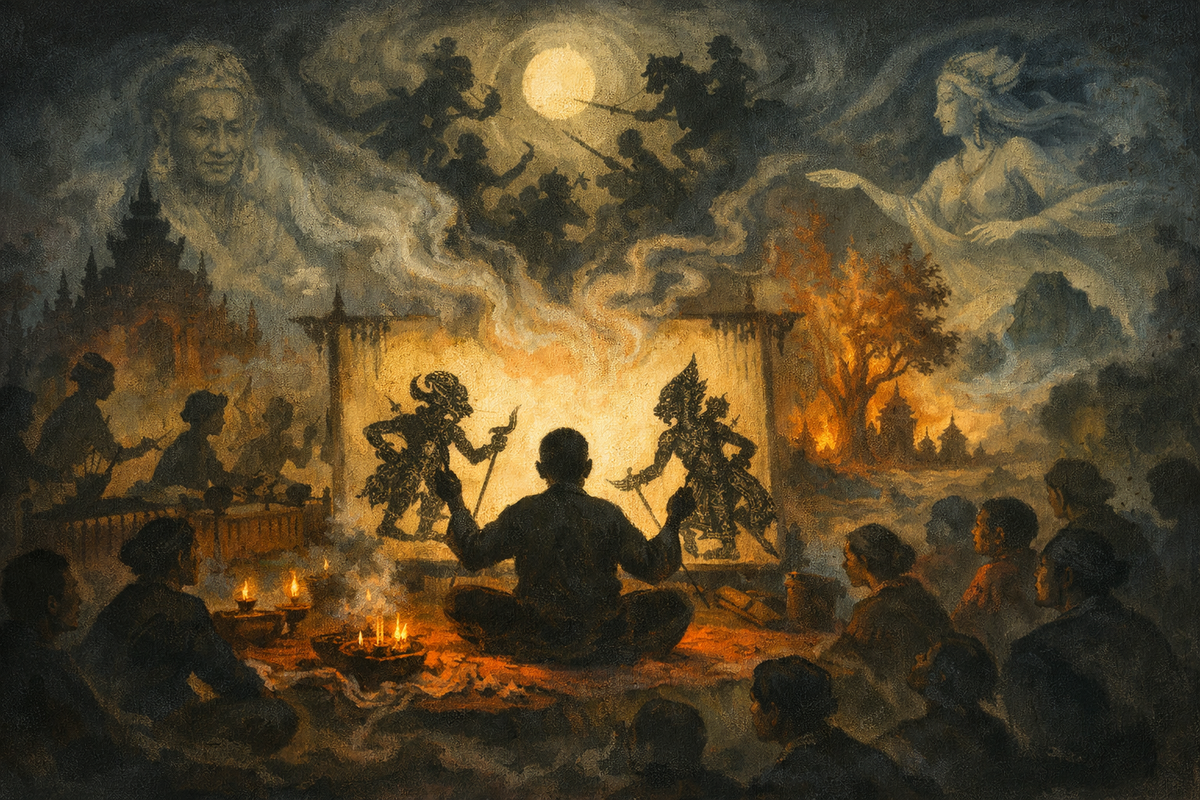
if the Namsadang piece showed the traveling troupe as a carrier of public permission, wayang lets the series take the next step and say something stronger. sometimes the liminal performer is not only a tolerated outsider, a comic critic, or a virtuoso body at the edge of the village. sometimes the performer is explicitly understood as a mediator between worlds. that is what makes wayang so important here. it is one of the clearest cases in the archive where performance, ritual, instruction, cosmology, and social gathering are not separable without misunderstanding the whole form.
the figure at the center is the dalang, the puppet master, narrator, voice-field, conductor of rhythm, manipulator of images, and operator of the all-night event. modern description often reduces him to master puppeteer because puppetry is the most visible surface a tourist or distant scholar encounters first. that is true in the same impoverished way calling a priest a public speaker is true. yes, speech happens. yes, figures are manipulated. but the office is much larger. the dalang is managing a threshold event in which visible and invisible orders are made to coexist for a night under one frame.
that matters for this series because it makes the sacred side of the liminal argument impossible to avoid. in earlier pieces i have been saying that pollution and the sacred are structurally close because both involve set-apart handling of dangerous thresholds. wayang is one of the places where the handling is openly coded as sacred mediation rather than hidden beneath a more openly stigmatized occupation. the performer is still at an angle to ordinary life. he is still a specialist in a charged role. but here the charge is not merely something respectable society disavows. it is something the community names and gathers around.
the dalang as operator
the dalang matters because he does too many things at once for modern categories to hold comfortably. he is not only a technician of puppets. he voices many characters, controls pacing, cues the gamelan, shapes mood, interprets inherited narrative, inserts local reference, and manages the rhythm of collective attention across an event that traditionally runs through the night. that alone would make the role substantial. what gives it liminal force is that the office has long been treated as requiring more than theatrical competence. discipline, apprenticeship, ritual preparation, and an understanding of the event’s cosmological weight belong to the role as well.
the all-night structure matters. a short theatrical entertainment can amuse and disappear. an all-night performance alters the social time of the community. it takes people out of ordinary labor rhythm and gathers them under a different order long enough for stories, jokes, teachings, emotions, and spiritual textures to sink below the level of brief diversion. the dalang is not only filling time. he is reordering it.
that is why i am not comfortable describing wayang as simply storytelling with puppets. storytelling is part of it. but the point is not only narration. the point is to make a shared world present. ancestors, epics, ethical conflict, cosmic tension, humor, erotic play, political commentary, and protective ritual all arrive in one field. the performer is the one holding that field open.
the puppet is not only representation
one of the most revealing things about wayang is that the puppet does not behave like a modern secular prop. it is not merely an object standing in for a character the way a toy figurine might stand in for a person in a child’s game. inside the tradition, the figures have weight. they sit inside a field of relation to story, spirit, memory, and inherited form that makes them more than inert tools. i do not need to overstate this into a naive claim that every puppet is simply treated as literally alive at all times. what matters is that the ontology is thicker than modern theatre language usually admits.
the puppet is one reason the dalang can do what direct human speech could not do as easily. once social contradiction, cosmic conflict, or political allegory passes into figure, shadow, voice, and rhythm, it becomes receivable at a different depth. people can encounter force under cover of form. the puppet protects the audience from blunt exposure and protects the message from immediate retaliation. this is one reason puppet traditions recur so often in liminal archives. they are machines for saying difficult things in metabolizable form.
in wayang, that saying is not only political or comic. it is cosmological. the puppets stage an ordered but unstable world in which visible life, spiritual power, inherited narrative, and current circumstance all brush against one another. the dalang is the one who can hold those brushes without collapsing them into chaos. that is what makes him a mediator rather than a mere performer.
ritual, pedagogy, and protection
modern audiences trained by commercial entertainment tend to ask first whether a performance is art, education, religion, or social event. wayang is useful precisely because it answers yes to all of them and refuses the implied demand to choose one. it teaches epic material. it stages moral and political tensions. it gathers a public. it marks occasions. it can be linked to rites of passage, communal observance, and protective or balancing functions. the very refusal to separate those functions is part of what makes the tradition liminal in the strong sense.
what the village receives from such a night is not one thing. catharsis is part of it. instruction is part of it. collective emotional regulation is part of it. a sense that the visible world is nested inside a larger order is part of it. and because all of this is delivered through an outer-band specialist rather than through the ordinary face of the settled order, the delivery has a flexibility it might otherwise lack. the performer can move between comedy and metaphysics, obscenity and instruction, local gossip and inherited sacred material, with a freedom respectable official discourse often cannot sustain.
that flexibility is the gift. a civilization needs more than one mode in which to know itself. official doctrine is one mode. bureaucratic record is one mode. wayang is another. it is a form in which knowledge enters through image, sound, repetition, and extended collective attention. destroy that form and the knowledge does not simply move over intact into a schoolbook. part of it evaporates.
the liminal specialist at the sacred edge
this is where the wayang case helps the whole series sharpen its language. earlier essays might tempt a reader to imagine that the liminal caste is always primarily a degraded outer class that only secondarily acquires spiritual residue. wayang reverses the emphasis. here the spiritual and cosmological function is obvious from the front. but the role is still structurally liminal. the dalang is not merely an ordinary villager speaking from no special position. he is set apart by training, office, ritual association, and performative authority. ordinary people gather. he operates.
that set-apartness belongs to the same family as the cremation worker’s charge or the Griot’s licensed speech. the valence changes. the mechanism remains. society locates a dangerous or powerful function in a specialist body that is not simply interchangeable with ordinary membership in the center. once you see that, the opposition between sacred mediator and stigmatized outsider starts looking less like a genuine difference in kind and more like a difference in how the culture chooses to narrate its own dependency.
the dalang is one of the clearest examples of what the middle essays will need to say openly: the liminal figure is not peripheral to culture. the liminal figure is one of the conditions under which culture generates itself. Huizinga will matter later for exactly that reason. play, spectacle, and performed world-making are not the opposite of civilizational seriousness. they are among its oldest engines.
what survives when modernity thins the world
modernity changes wayang in ways now familiar from other traditions in the series. state cultural policy, tourism, formal stage adaptation, media circulation, shortened attention spans, and the conversion of living social forms into heritage objects all push on the tradition at once. the art survives, which matters. but survival inside modern display is not identical to survival inside the older social ecology that made the all-night communal event a working piece of village and ritual life.
that is not a reason for nostalgia without discipline. traditions always change. but it is a reason to say clearly what kind of loss modern translation produces. once wayang is received only as aesthetic treasure, some of its social and cosmological thickness is shaved away. the puppet remains visible; the world the puppet once helped hold open becomes harder to feel. what is lost is not only belief. it is mode. a community loses one of its ways of knowing together.
one of the things that makes this loss hard for modern people to register is that modernity is better at storing content than at preserving form. scripts can be archived. puppets can be displayed. recordings can be made. training can be institutionalized. all of that matters, and none of it is nothing. but the old density of the event depended on more than content survival. it depended on a social world willing to dedicate a night, a community, a rhythm of attention, and a cosmological seriousness to the performance. once those conditions thin, preservation becomes partial no matter how sincere it is.
wayang also helps clarify why the liminal role cannot be reduced to social rebellion. sometimes the performer’s work is explicitly conservative in the deep sense. it conserves cosmology, memory, ethical tension, and relation to inherited stories. but the conservation only works because the form remains flexible, comic, thick with side commentary, open to local insertion, and alive enough not to become dead doctrine. the liminal specialist is therefore not simply the enemy of order. he is often the one keeping order from becoming a corpse.
that doubleness is exactly why the role persists across civilizations. the center needs preservation, but preservation without liminal flexibility becomes sterile. the edge brings life back into continuity. the dalang is one of the clearest examples in the series because the office is visibly charged with both inheritance and improvisation. he receives a world and remakes it publicly without pretending to have invented it from nothing. that is a rarer civilizational competence than modern institutions like to admit.
if i had to compress the whole essay into one sentence, it would be this: wayang shows that the liminal performer is not merely a tolerated entertainer standing near the sacred, but one of the trained human technologies by which the sacred, the comic, the political, and the communal are kept in conversation rather than being split into separate dead compartments.
that loss matters to the series because it will recur again and again in the modernity block. functions survive. containers thin. expertise is professionalized, aestheticized, or archived. the role remains intelligible only in fragments. wayang shows what one of the richest premodern containers looked like before the thinning is complete.
the next essay moves west again, into europe, where the Dom diaspora meets an already-existing carnival tradition and the liminal archive goes explosive. if wayang gives us the sacred puppet at full cosmological thickness, the european convergence gives us the fool, the mountebank, the fairground, and the licensed inversion of rank at continental scale.
This is Part 8 of the liminal caste series.
Previous: the namsadang: korea’s traveling players | Hub: the liminal caste | Next: the european convergence: roma meets carnival