the dom: where it begins
there is a caste in northwestern india called the Dom. in the languages the caste has historically spoken, the same word, or a close cognate, is also an old word for human being. the caste’s position in the social order for as long as anyone has been recording it has been outside the normal fourfold varna hierarchy, dalit in the classification that became official in modern india, untouchable in the older language of the caste system itself. their traditional occupations have been a specific cluster: music and performance, metalworking, basket-weaving, and the handling of corpses at cremation grounds. they have been, in the places they lived, simultaneously necessary and unclean. the series begins with them because they are the most documented case of a pattern that, as the following essays will show, recurs in almost every stratified society humans have ever built. they are the headwaters.
i want to spend this first essay on why i am choosing the Dom as the point of departure, on what the historical record does and does not say about them, on the linguistic trail that links the Dom to the Lom of the caucasus and anatolia and the Rom of europe, and on why this particular case, out of all the cases the series will look at, is the one that makes the structural argument visible over the widest span of time. the claim is not that the Dom invented the pattern. the claim is that the Dom trail is the longest-running single line of the pattern we can still follow. the trail begins in india roughly a thousand years ago and it has not stopped running.
the name and the caste
the term “Dom” in the north indian context refers, in the present and in the historical record, to a cluster of related jatis, what the english-language shorthand would call a caste group rather than a single lineage. they have been documented across uttar pradesh, bihar, himachal pradesh, and into the western himalayas. their jati-specific names are many; Mahadev-Dom, Dom Patra, Dom Raja, depending on region and the specific sub-occupation, and their actual material conditions and social standing have varied in the way that any large population’s conditions vary across place and time. in an older literature they are sometimes written as Ḍom or Doom to distinguish the retroflex initial from the english D. Ian Hancock, the Romani linguist and historian, points to this retroflex initial as among the clearest pieces of evidence that the word moves with the people as they migrate, preserved in the phonetic architecture of the Romani language long after the migrating community has lost contact with the subcontinent.
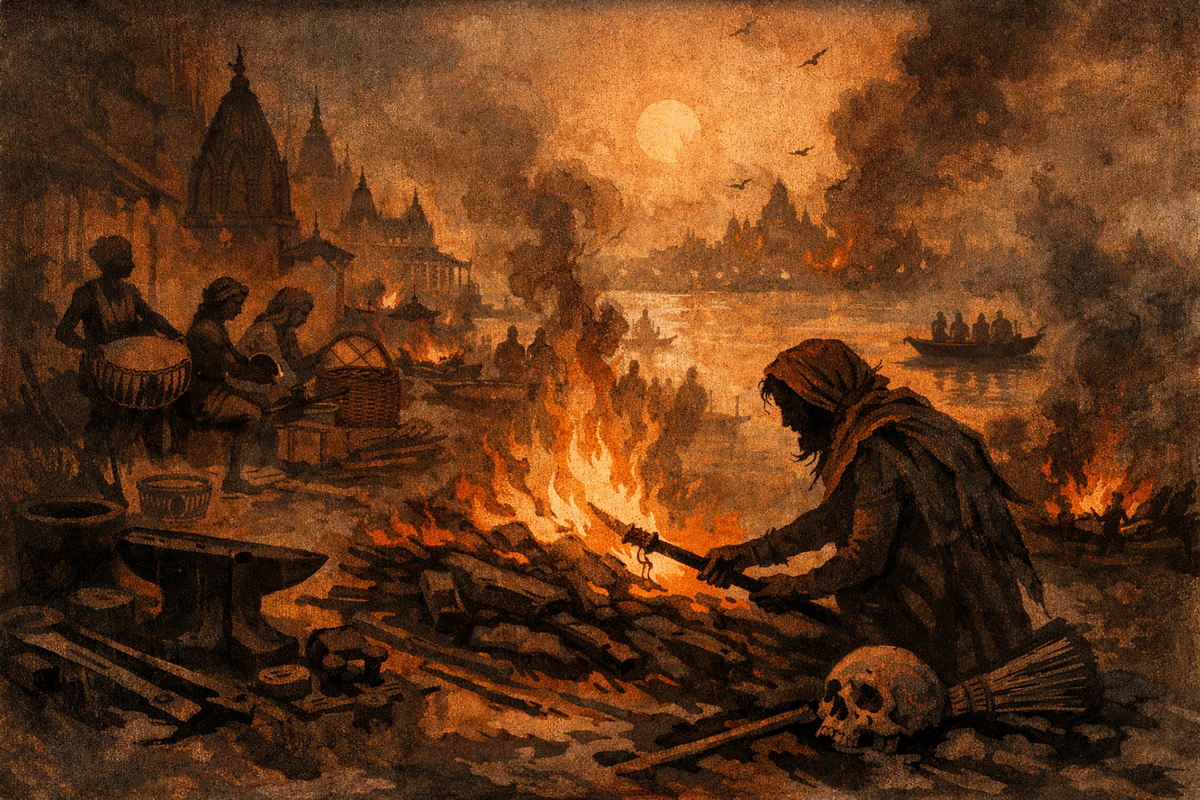
the caste position matters structurally. they are dalit, which means, in the terms of the caste system itself, outside the ritual purity that the four varnas are organized around. that outsider position, paradoxically and as later essays in this series will develop, is also what makes them essential. the brahmanical ritual apparatus, for all its elaboration of distinctions, had a specific limit. it could not itself handle death. it could not dispose of the corpse. it could not operate the cremation ground. the pollution of the body at the moment of death is, in the apparatus’s own terms, catastrophic. someone has to do this work. someone has to burn the bodies. someone has to sweep the ground after. that someone is the Dom, in most of northern india, for most of recorded history. the burning ghats at Varanasi, the most sacred cremation ground on earth in the Hindu imagination, have been operated by Dom families for generations. the Dom Raja of Varanasi, as the position is called, holds the fire that has been kept alive in a single hearth for, depending on whose account you trust, several centuries to several millennia. every cremation that happens at Manikarnika Ghat is lit from that fire. the man who hands down the flame to the mourner lighting the pyre is dalit. his flame is sacred. this is not a contradiction. this is the whole argument of the second essay in this series.
the caste’s other occupations extend the same principle. music and performance have been Dom trades; the percussion traditions of wedding bands and funeral processions across much of northern india still involve Dom musicians, and the specific instruments associated with the caste are the dholak, the naqqara, and various drums played in the context of ritual transitions rather than concert settings. metalwork, especially blacksmithing and iron-handling, has been another traditional Dom occupation; the association with fire and with heavy physical labor is consistent across the occupations. basket-weaving and similar work with cane and bamboo is another. what these occupations share is a specific kind of handling: things whose handling the rest of the social order would rather not know about, done at the threshold between settled life and what settled life depends on to keep working.
the migration
something happened around the year 1000 CE that set some part of this population in motion westward, and the descendants of that motion are the Roma of europe, the Lom of the caucasus and anatolia, and the Dom populations of the middle east, Egypt, and adjacent regions. the when and the why are contested in the scholarly literature. what is not contested is the linguistic evidence. the Romani language spoken by the European Roma, the Lomavren spoken historically by the Lom of armenia and turkey, and the Domari spoken by Dom populations in the middle east and north africa are Indo-Aryan languages with a demonstrable close relationship to each other and to the languages of northwestern india as those languages existed around the end of the first millennium CE. Yaron Matras, one of the principal linguists of Romani, has documented the grammatical and lexical features that date the proto-language of this group to the medieval north indian linguistic space. the migrating communities preserved enough of their source grammar, deep in the architecture of the languages they have spoken ever since, that you can read the place and period of their origin off the languages themselves.
the trigger event most commonly associated with the migration, though by no means universally accepted, is the series of invasions mounted by Mahmud of Ghazni into northern india between roughly 1000 and 1026 CE. Mahmud’s raids were brutal and extensive; they penetrated deep into the gangetic plain, they destroyed temples, they took vast quantities of plunder and captive populations, and they are thought by several historians of the Romani people, Donald Kenrick among them, to have either removed significant populations from the affected regions as military auxiliaries, craftsmen, and entertainers, or to have so disrupted the pre-existing social order that populations already somewhat mobile by tradition, the Dom in particular, began moving westward in waves. Kenrick’s reading, which i find careful without being conclusive, is that what eventually became the Romani diaspora probably began as multiple waves of movement over two or three centuries, with the Ghaznavid invasions as the first and largest shock but not the only one.
other accounts place the migration earlier, or see it as a gradual economic movement rather than a response to any specific military event. ian hancock has argued for a more complicated picture in which the Dom were already mobile, already stateless by design, already portable by necessity, and the Ghaznavid period intensified a tendency that the structural position of the caste had built into it for centuries. the caste was not rooted to a single village in the way a cultivating jati might be. they went where their work went, which means they went where weddings and funerals and markets and mourning were, and the markets and funerals of a dynamic region in that period crossed the frontiers that would later become national borders without much resistance.
whatever the proximate trigger, the result is reasonably clear. by the eleventh and twelfth centuries the population was in motion. by the fifteenth century, Romani communities are documented across the balkans and into central europe. by the sixteenth they are in western europe, including britain, where the earliest parliamentary acts concerning them refer to them as “Egyptians,” a designation that is etymologically the source of the slur gypsy in english usage and a reminder that the host societies, then as now, did not know what they were looking at. what they were looking at was the dalit caste of northern india a few hundred years and several thousand miles out from where they had started.
what survived in the language and the trade
the linguistic family tree is the cleanest evidence that the three populations, Dom, Lom, Rom, come from a common source. Matras and Hancock both document that the sister languages share a core grammatical architecture that can only have diverged from a common ancestor, and the ancestor they diverged from was an Indo-Aryan language in the northwestern indian linguistic continuum at the end of the first millennium CE. this is, in terms of the available evidence, as tight a case as historical linguistics ever produces for a migration of this length in time and distance.
what survived alongside the language was the trade. music, performance, metalwork, handling the boundaries between ordinary life and the things ordinary life needs to happen. the Roma who arrived in western europe in the fifteenth century were musicians, horse traders, metalworkers, basket weavers, fortune tellers. the specific occupational cluster the Dom had carried in northern india was still, in recognizable form, the occupational cluster of their descendants six centuries and several thousand miles later. this continuity is, i think, what is most striking and what this series is most interested in. the position is not preserved by institutional structure; there were no portable institutions that carried it. the position is preserved by the shape of the work and by the social function that work serves.
the same position reappears, or survives through the contact, in the carnival tradition of catholic europe, which a later essay in this series will develop in detail. the mountebank, the charlatan, the traveling medicine seller, the carnival barker, the fortune teller, the tinker: these are the european names for occupations that map, occupation for occupation, onto the trades the Dom had been doing in northern india for as long as there are records. the european host societies did not inherit these occupations from the incoming Roma directly; some of them existed in europe before the arrival. what the european convergence produced, however, was a situation in which two versions of the same structural position met and combined into the european carnival form that ran from the late middle ages through the nineteenth century before modernity dismantled it.
why start here
this is what i mean when i say that the Dom are the headwaters. not that every subsequent case in this series descends from them, because the cases developed independently; the Burakumin of japan and the Griot of west africa are not descended from the Dom, and the argument of this series does not depend on that kind of genealogical transmission. what the Dom trail shows, and what no other single case can show with the same time depth, is the same social position persisting across a millennium of geographical movement, language change, religious conversion, host society after host society, each of them receiving the same figure and giving it some version of the same social treatment. the same work. the same stigma. the same paradoxical cultural centrality. across a thousand years and three continents.
the rest of the series works case by case across other civilizations that produced their own, independent version of the same figure, and then, in the middle of the series, asks the question the cases make unavoidable. why is this pattern so stable. what is the structural position doing that every complex society apparently needs it to do. what happens to a civilization that tries to erase the function rather than rename it. the answers will draw on Mary Douglas and on Huizinga and on Victor Turner’s work on liminality in the terms of the later essays, but the answers are, i think, already visible in the trail i have just traced. something about the Dom position has been needed, in recognizable form, in almost every complex society that has existed. something about that position, and about the people the position requires to exist, does not go away when the host society moves against it. this is what we are going to be looking at for the next eighteen essays. the Dom trail is the frame.
one final note before the next essay. what the Dom have cost as the price of filling that position, and what the Roma have cost in particular over the last several centuries, is not a small thing and i do not want to glide past it here. multigenerational poverty. systematic exclusion. the periodic massacres that punctuate the record from the balkans to england to spain, culminating in the Porajmos, the roma genocide during the nazi period, which killed somewhere between five hundred thousand and one and a half million people and which the post-war historical record has struggled to acknowledge with anything like the seriousness it acknowledges the shoah. these costs are real and they are a central subject of a later essay in this series. the argument that the liminal caste is structurally generative, that it gives the host society something the host society cannot generate for itself, is not an argument that the cost is acceptable or that the figures who have carried the position have been adequately compensated for what the position demanded of them. they have not been. that reckoning is part of the work this series is trying to do.
the next essay is on the specific paradox that sits at the center of all the cases. the worker at the cremation ground and the priest at the altar are, in structural terms, doing the same work from opposite ends of an apparent divide the society itself constructed. the pollution and the sacred, as Mary Douglas saw clearly, are the same category.
This is Part 1 of the liminal caste series.
Hub: the liminal caste | Next: the untouchable as spiritual specialist betika sign up