why every society generates this figure
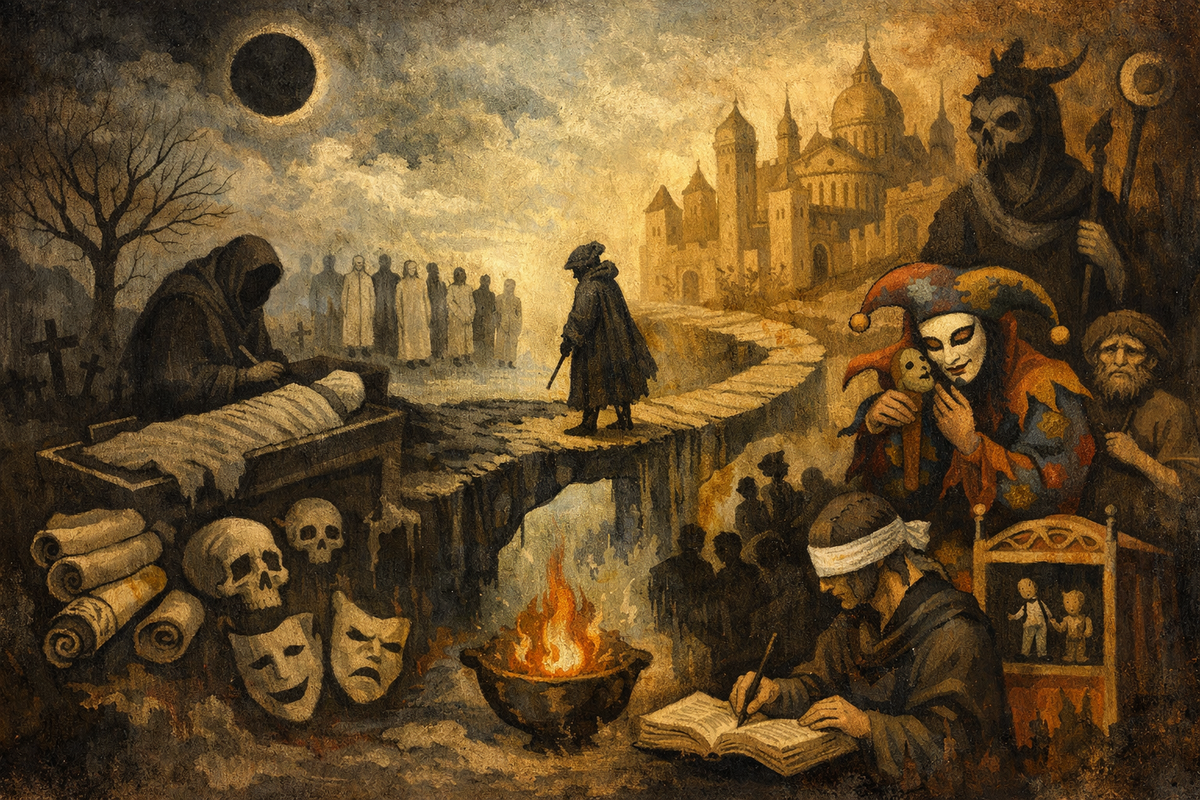
after enough case studies, pattern recognition stops being speculative and becomes mandatory. at some point one has to stop saying here is another curious resemblance and ask the sharper question. why does this keep happening. why do societies separated by language, religion, political form, and historical contact keep generating figures who stand at the edge of the social order while carrying functions the social order cannot seem to do without.
the answer i have been moving toward is not mystical. it is structural. every complex society must solve certain problems if it wants to remain both materially functional and psychologically coherent. bodies die. memory must be preserved. conflict must be voiced. status contradictions must be managed. thresholds between ordinary and extraordinary life must be crossed in ways the group can survive. the catch is that many of these tasks threaten the very categories by which the center understands itself. so the center externalizes the task while retaining the benefit. once externalized, the task begins to generate a specialist population around itself. that population becomes hereditary or caste-like when the function is stable enough and the stigma attached to it is strong enough to keep it socially bounded.
that is the broad mechanism. the details differ. one society builds the role around death work. another around genealogy. another around itinerant performance. another around prophecy or carnival inversion. but the recurrence is not arbitrary. the figure keeps appearing because the problems keep appearing.
death work
the first problem is death. every society must dispose of bodies, process grief, and manage the terrifying threshold at which a person becomes something else. this is not only a logistical problem. it is a symbolic catastrophe if not handled properly. a social order built on stable categories cannot simply absorb the corpse into ordinary life without special procedure. so someone has to handle the threshold. where that someone is placed tells you a great deal about the culture.
in some worlds the handler becomes strongly polluted. in others the work is split across more than one role. in modernity the work becomes institutionalized in medicine, funeral industry, law, clergy, and bureaucratic procedure. but the problem never disappears. someone must touch what the ordinary order wants to refuse touching. the liminal figure is one answer to that demand.
memory work
the second problem is memory. power distorts memory by nature. rulers prefer flattering pasts. noble lineages prefer clean genealogies. nations prefer redemptive myths. a society that wants usable continuity must therefore find some way of holding memory at a slight angle to current power. the hereditary outside specialist is one such way.
this is why the Griot is so revealing, but the mechanism is broader than west africa. patron musicians, storytellers, satirists, court fools, ritual reciters, and other edged figures all keep appearing where continuity needs a human carrier not fully identical with the people being remembered. memory from the center alone becomes propaganda too easily. memory from the edge is riskier, but often truer.
truth work
the third problem is truth. not truth in the abstract, but socially survivable truth. how does a society let contradiction, criticism, humiliation, and the naming of hypocrisy reach the center without the whole structure moving immediately to punitive self-defense. one answer is to create a licensed edge figure. the fool says it. the puppet says it. the singer says it in praise thick enough to contain rebuke. the carnival says it under mask.
this is why so many liminal specialists are also performers. performance is one of the oldest ways of changing the cost of speech. what would be unbearable as naked statement becomes receivable in role, rhythm, costume, or ritual frame. the truth arrives obliquely and therefore lands.
boundary work
the fourth problem is boundary itself. societies need categories and constantly encounter experiences that overflow them. blood, sex, trance, animals, waste, madness, ecstasy, spirit, disguise, seasonal inversion, strangers, the dead, the not-quite-human object that speaks in a puppet booth; none of these fit comfortably inside a purely orderly map. so societies develop threshold specialists. the vocabulary comes from van gennep and victor turner; i lay out the background in what is liminality?.
the specialists do not all look alike because the boundary they handle is not always the same. but the family resemblance is strong because the social logic is strong. the ordinary center wants the threshold crossed without having to live there. the liminal figure is the delegated inhabitant of the crossing point.
why heredity enters
one of the hardest parts for modern egalitarian language to think clearly about is why these roles so often become hereditary. the reason is not mysterious. if the function is durable, specialized, socially necessary, and stigmatized, heredity is one of the easiest ways for a civilization to stabilize it. training passes through family or bounded group. repertoire stays intact. the wider society does not have to renegotiate who will do the dangerous work each generation. stigma helps seal the boundaries. the arrangement becomes self-reproducing.
that does not make heredity just. it makes heredity socially efficient for the order using it. the question is not whether the arrangement is admirable. the question is why it recurs. societies keep rediscovering that the cheapest way to secure indispensable threshold labor is to attach it to a population already marked as different.
why modern societies still do it
modern people like to imagine this is all premodern irrationality. but modern societies still generate the figure; they simply distribute it differently. the therapist holds dangerous truth and grief at professional remove. the funeral director handles the corpse. the comedian says what politics cannot say directly. the journalist holds adversarial memory. the sanitation worker handles literal contamination. the online anonymous account speaks from outside ordinary consequence. the vessel changes. the function does not.
what modernity often does is sever the functions from one another and place them in separate institutions rather than in one outer-band population. that reduces some forms of hereditary stigma, which matters. it also often thins the knowledge that used to accumulate when several functions were held together across generations inside one durable social role. modernity solves one problem and creates another.
the figure is a solution, not a leftover
this is the sentence i most want the essay to earn. the liminal figure is not social debris. the figure is a recurring solution to recurring civilizational problems. once you see that, everything changes. contempt becomes evidence. stigma becomes camouflage. the outer band stops looking accidental and starts looking designed, even if the design was never consciously admitted.
the next essay turns one side of that design into plain language. the freedom and the stigma are the same thing because the role requires both distance and access. that paradox has been present in every case already. now it needs to be named directly.
and that is why the recurrence matters more than origin. once several civilizations have rediscovered the same answer independently, the answer stops looking exotic and starts looking diagnostic. the liminal figure is one of the tests by which complex societies reveal what they cannot do honestly from the middle of themselves.
the deeper one looks, the less surprising the recurrence becomes. stable orders are never as stable as they imagine. they depend constantly on people, rituals, and roles capable of handling what stable order excludes conceptually but cannot exclude materially. once one grasps that, the liminal figure stops looking like an exception at the margins of civilization and starts looking like one of civilization’s recurring self-corrections.
that does not mean every society gets the arrangement in the same proportion or with the same moral temperature. some societies sacralize the figure more openly. some degrade it more brutally. some split the functions across several roles. some consolidate them more densely. but the underlying question remains recognizable: who will handle what the center cannot bear to own directly. that question is old enough, and permanent enough, that the recurrence is exactly what one should expect.
This is Part 11 of the liminal caste series.
Previous: the essential gift: what the liminal caste actually gives | Hub: the liminal caste | Next: the freedom and the stigma are the same thing