
The Markov Blanket Method for Relationships
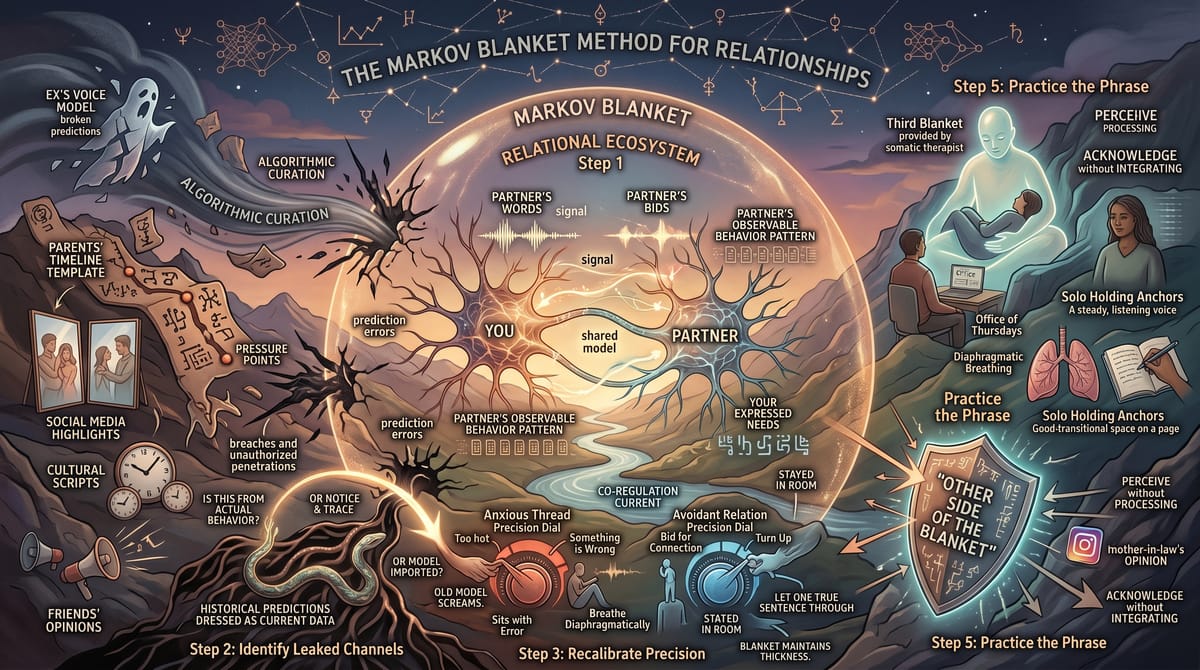
No new theory in this chapter. Everything you need is in the first seven. This is the application; the protocol, the exercises, the things you can do Tuesday morning that move this from a framework you understand to a practice you live.
Take what’s useful. Leave what isn’t. Come back to the rest later.
Step 1: Map Your Blanket
Get a piece of paper. Draw a circle. This is the Markov blanket of your relationship. Everything inside the circle is signal; the data your relationship should be running on. Everything outside the circle is noise; data that doesn’t belong in the model.
Inside the circle, write down the actual sources of information your prediction engine processes about this relationship. Be specific.
Your partner’s direct words to you. What they actually say, not what you interpret, not what you read into the silence, not what you imagine they’re thinking. The words.
Your partner’s bids for connection. The hand on the shoulder. The question about your day. The look across the room. The text that says nothing important but means I’m thinking about you. These are sensory inputs. They belong inside the blanket.
Your partner’s observable behavior over time. Not a single incident interpreted through a crisis model. The pattern. The accumulation of data points that your prediction engine should be running on.
Your own expressed needs and bids. The things you’ve actually said, asked for, put into the space between you. These are your active states. They belong inside the blanket too.
Now, outside the circle, write down what’s been penetrating your blanket without authorization.
Your ex’s voice. The model of relationships built in a previous system, running predictions inside a system it has nothing to do with. If you hear your ex’s words when your current partner does something that doesn’t match what your ex did, that’s an external state updating an internal model. Write it outside the circle.
Your parents’ marriage. The template that was installed before you had language. If you find yourself measuring your relationship against theirs; either trying to replicate it or trying to escape it; that’s an external model penetrating the blanket. Outside the circle.
Social media. The algorithmic curation of other people’s best moments measured against your private worst. If you’ve ever felt something shift in your chest after scrolling past someone else’s relationship content, that was a prediction error generated by an external state. Outside the circle.
Cultural scripts. The timeline for when you should be married, when you should have kids, when you should have figured this out. Society’s model of how relationships should progress. If you feel pressure that you can’t trace to an actual conversation with your actual partner, it’s probably a cultural model that breached the blanket. Outside.
Your friend group’s opinions. The unsolicited assessments, the comparisons, the well-meaning advice that’s actually a projection of someone else’s relational model onto yours. Outside.
Look at the circle. Look at what’s inside. Look at what’s outside. Most people discover that their prediction engine has been running on significantly more external data than internal data. The relationship’s model has been contaminated by signals that don’t belong to it. The prediction errors that have been causing suffering aren’t coming from inside the system. They’re coming from noise that got through the blanket.
Step 2: Identify Leaked Channels
This is the harder pass. The first step catches the obvious intruders. This step catches the ones wearing disguises.
A leaked channel is a pathway through which external states are updating your internal model while appearing to originate from inside the system. These are the most destructive because you act on them as though they’re real signals from the relationship, when they’re actually historical predictions dressed up as current data.
The most common leaked channel: your own attachment predictions from previous environments.
When your partner goes quiet and your chest tightens, ask the question: is this prediction coming from what this person has actually done, in this relationship, over the pattern of our time together? Or is it coming from a model built by someone else, in a different relationship, that’s running inside this one?
This is not the same as dismissing your feelings. The feeling is real. The prediction error is real. But the source matters. A prediction error generated by actual data from the current relationship is signal. A prediction error generated by a model imported from a previous relationship is noise wearing the mask of signal. Both feel identical in the body. Telling them apart is the skill.
Another common leaked channel: the prediction that you know what your partner is thinking.
Mind-reading is a prediction engine running without sensory data. It’s the model generating outputs based on priors alone, without checking them against actual evidence from the other person. “I know they’re upset with me” is a prediction. “They told me they’re upset with me” is data. The prediction may be accurate. It may not. But when you act on the prediction without checking it against sensory evidence, you’re running on a leaked channel; you’re treating your model’s output as though it were input from the relationship.
A third: the prediction about what your partner’s behavior means.
“They didn’t come to bed when I asked” is data. “They don’t care about our intimacy” is a model. The data belongs inside the blanket. The model’s interpretation of the data needs to be checked before it starts updating your predictions about the relationship. When interpretation runs unchecked, the model generates meaning from its own priors rather than from the actual evidence, and you find yourself in a fight about what something meant when you never confirmed that it meant anything at all.
For each leaked channel you identify, the practice is the same: notice the prediction, notice its source, and decide whether to act on it or gather more data. Not suppress it. Not argue with it. Not gaslight yourself into thinking the feeling isn’t there. Notice it, trace it, decide.
Step 3: Recalibrate Precision
This is the daily practice. It’s specific to your attachment configuration, and it requires you to do the opposite of what your system wants.
If you trend anxious:
Your threat channels are running too hot. The precision dial on “something is wrong” signals is cranked to maximum. Every ambiguous cue gets processed as potential abandonment at full volume.
The practice: when you notice the threat signal fire on an ambiguous cue, pause. Don’t act on the signal. Don’t seek reassurance. Sit with the prediction error for sixty seconds longer than is comfortable. Breathe diaphragmatically. Let the vagal brake hold you in ventral while the prediction engine screams its old model.
After sixty seconds, ask: what is the actual evidence? Not what the model says. What the data says. Did your partner’s behavior, interpreted without the threat amplifier, actually warrant this level of alarm? If yes, gather more data. Ask them. If no, note it. My system generated a prediction error from the old model. The current data doesn’t support it. I’m going to let this one pass without action.
Do this ten times and nothing happens. Do this a hundred times and the precision weight on the threat channel starts to shift. Not because you told it to. Because you gave the prediction engine a hundred data points that said: the threat prediction fired and the threat didn’t materialize. The model updates through accumulated disconfirmation.
If you trend avoidant:
Your relational channels are running too cold. The precision dial on “bid for connection” signals is turned down so low that most of them don’t register.
The practice: when your partner makes a bid for connection; any bid, including the ones that feel like nothing; notice it. Don’t evaluate it. Don’t decide whether it deserves a response. Notice it. Register that a signal arrived. And respond. Not with a performance of intimacy. With one true thing. One sentence more than “fine.” One moment of staying in the room when the system says to leave it.
The avoidant system will resist this. It will feel unnecessary, exposing, slightly dangerous. That feeling is the blanket trying to maintain its thickness. The practice is not to tear the blanket down. It’s to open one channel, one interaction at a time, and let one signal through.
After a hundred reps of this, the precision on relational data nudges upward. The system starts to register bids it would have missed. Not because you forced it. Because you gave the prediction engine a hundred data points that said: a signal got through and the system survived.
If you trend disorganized:
The practice is different because the system is running contradictory models simultaneously. The approach isn’t precision recalibration; it’s model stabilization. And it almost certainly requires a third nervous system.
Find a therapist who works somatically. Not just cognitively. The disorganized system needs a holding environment that is reliably safe and that the system can learn, very slowly, to predict as safe. This is the hardest recalibration in the book because the system that needs updating is the same system that sabotages the conditions for updating. The prediction “the holding environment is dangerous” prevents the system from receiving the very evidence that would disconfirm it.
A skilled therapist provides the third blanket. They hold the space while the prediction engine slowly, slowly learns that this holding environment is not the one that trained it. The errors are tolerable because someone else is holding the boundary while the system figures itself out.
Step 4: Build Holding Environments
A holding environment isn’t a person. It’s a relational condition. Identifying where you have them, and where you don’t, changes what’s possible.
You have a holding environment when: you are in the presence of another nervous system that is regulated enough, often enough, that your system can use it as a reference point. A partner who returns to calm reliably. A friend who listens without fixing. A therapist whose regulated presence holds the space while your system does its work.
This doesn’t have to be a romantic partner. It’s worth saying that explicitly, because a lot of attachment literature implicitly assumes you’re doing this work inside a couple, and if you’re single or between relationships, the whole framework can feel like it requires a prerequisite you don’t have. It doesn’t. The friend you can call at 10pm who doesn’t try to solve your problem but whose voice settles something in your chest; that’s a holding environment. The weekly dinner with someone who knows your history and whose presence your system has learned to predict as safe; that’s a holding environment. The therapist you see on Thursdays whose office your nervous system recognizes before you’ve said a word; that’s a holding environment, and it may be the most important one, because it’s the one specifically designed for the prediction errors you’re trying to process.
You also have a holding environment when: your own diaphragmatic breathing practice, built through the work in Chapter 4, gives your system a self-generated regulatory anchor. Your own vagal brake, engaged consciously, holding you in ventral while the prediction engine processes its errors. A morning walk at the same pace along the same route, where the predictability of the environment lets the system downshift from scanning to settling. A journaling practice where the act of writing externalizes the prediction error, moves it from the body’s interoceptive loop onto the page, and the distance between you and the words creates just enough transitional space to observe the model rather than be captured by it. These are solo holding environments. They don’t replace relational ones, but they give the system a floor; a minimum level of regulation you can access when no other nervous system is available.
You lack a holding environment when: every relationship in your life is a source of prediction error rather than a source of regulatory input. When the people around you are dysregulated themselves, or when their responses are so inconsistent that your system can’t use them as a stable reference. When you have no practice for self-regulation and no relationship that provides it.
If you lack a holding environment, building one is the first priority. Before blanket mapping. Before precision recalibration. Before any of the work in this chapter. The prediction engine cannot update in defense mode, and without a holding environment, the system stays in defense mode. The first investment is the relational or self-regulatory condition that makes everything else possible. Start where you can. One regulated friendship. One therapist. One breathing practice you actually do rather than intend to do. The holding environment doesn’t have to be perfect. It has to be good enough. Winnicott’s principle holds all the way through.
Step 5: Practice the Phrase
This is the simplest tool in the book and, for many people, the most immediately useful.
When external noise arrives at the boundary of your relationship and starts trying to update the model inside; when your mother-in-law’s opinions about your parenting start generating prediction errors in your partnership; when Instagram’s curated reality starts making your actual relationship feel insufficient; when your friend’s breathless account of their new partner starts making you wonder what you’re missing; when the cultural timeline says you should be somewhere you’re not; when the old model from the old relationship fires its old prediction in the new relationship; when any of this happens, the practice is five words:
“Other side of the blanket.”
Not an argument. Not a suppression. A recognition. This signal is arriving from outside the system. It doesn’t get to update the model inside. I can perceive it without processing it. I can acknowledge it without integrating it.
The phrase works because it gives the prediction engine a specific instruction: reclassify this signal. Move it from “data that updates my model” to “noise from outside the blanket.” The prediction error that was generating suffering inside the relationship gets correctly attributed to its external source, and the internal model stops treating it as evidence.
Say it to yourself. Say it to your partner, if they’re in the framework with you. Say it out loud in the car when the cultural script starts whispering that you’re behind. Say it silently in the bathroom at the family dinner when someone’s opinion starts updating a model it has no business touching.
Other side of the blanket. The relationship has enough real data to process. It doesn’t need to import errors from the world outside.
Step 6: The Couple’s Blanket Map
If your partner is in this with you; if they’ve read this far, or you’ve talked them through it, or they’re game for a framework even if they’d never pick up the book themselves; there’s a version of the blanket mapping exercise that changes the relational dynamic directly.
Sit across from each other. Each of you draws the circle. Each of you writes down, independently, what belongs inside the blanket (signal) and what belongs outside (noise). Don’t show each other yet.
Now compare.
What you’ll find, almost always, is that the two circles don’t match. One of you has placed “my parents’ opinion about our timeline” inside the blanket. The other has it outside. One of you has placed “how my ex handled this situation” inside the blanket without realizing it was there. The other can see it clearly because it’s obvious from outside.
The conversation that follows is not about who’s right. It’s about whose data is running inside the system. The signal-versus-noise distinction isn’t a judgment call; it’s a question about what the relationship’s prediction engine should be processing. And when two people can look at their blanket together and agree on what belongs inside and what doesn’t, they’ve built something more powerful than any exercise in a book: a shared model. A co-authored prediction about what this relationship runs on.
Do this quarterly. The blanket changes. New noise sources appear. Old ones you thought you’d handled sneak back through channels you forgot to close. The map needs updating because the territory keeps shifting. That’s not failure. That’s a living system doing what living systems do.
What This Adds Up To
These six steps are not a cure. They’re a practice. A daily engagement with the architecture of your own prediction engine, applied to the most complex system your prediction engine will ever try to model: another person.
Map the blanket. Know what’s inside and what’s outside. Identify the leaked channels. Know where historical predictions are masquerading as current data. Recalibrate the precision. Turn down what’s too loud, turn up what’s too quiet. Build the holding environment. Create the conditions where updating is possible. Practice the phrase. Correctly attribute what belongs to the relationship and what doesn’t. Map it together, if you can. Build a shared model that both systems can run on.
None of this replaces therapy. None of this replaces the actual relational work of two people learning to be a holding environment for each other. None of this is a shortcut past the slow, unglamorous, repetitive process of earning secure attachment through accumulated experience.
But it gives you a map. And a map, even an imperfect one, is the difference between wandering in the dark and walking with direction.