
streets and brothels
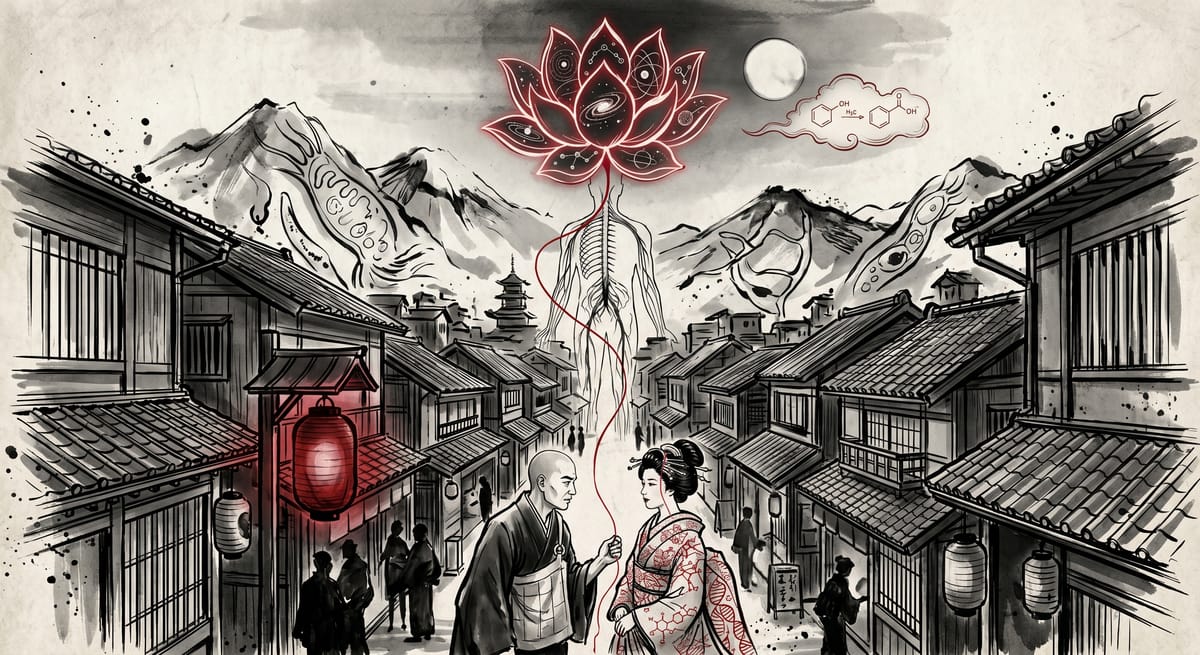
there is a fact about Ikkyu that the tradition still does not quite know where to put. for the last decades of his life, after he had refused the inka and walked out of the Rinzai establishment, he gave his teaching in places monks did not usually go. the streets of Sakai, the merchant port where refugees from the Ōnin War had collected. the brothels that operated near the temple districts, staffed by women sold into the trade as girls. the plague wards the credentialed abbots had fled. the funerals the credentialed monks would not preside over. his students, as the accounts come down to us, were hobos, criminals, prostitutes. the dharma he was teaching had no trouble finding them.
the question i want to press in this essay is a simple one. does where you teach the teaching form part of what the teaching is? because the standard reception of Ikkyu’s biography handles this the way most biographies handle an eccentric. the eccentricity is granted; the teacher is indulged for his oddness; the teaching, the real teaching, is still understood to have been given in the monastery, in the formal contexts where the Rinzai method could be properly transmitted. the teaching-in-brothels is color. it is flavor. it is what a biographer puts in the middle chapter to humanize the subject before returning to the lineage proper.
i am going to argue the opposite. i think where he taught was the teaching, or the better half of it, and i think reading his biography as though the location were incidental gets the whole Red Thread Zen argument exactly wrong.
the place the teaching went
start with the specific. Sakai in the second half of the fifteenth century was not a monastery town. it was the most active trade port on Japan’s main island, a merchant city whose power had grown precisely because it operated at some distance from the central court and the great religious establishments. after the Ōnin War, from 1467 on, Sakai absorbed huge numbers of refugees from the Kyoto district; artisans, displaced farmers, families of slaughtered samurai, the religiously homeless. Ikkyu, by this period in his life, had been living and moving in this layer of Japanese society for decades, settling for stretches in Sakai and traveling from there.
his students in that period were not, on the whole, the sons of samurai families placed in the temple for career reasons. they were people who had been churned loose by the war and the economy and the collapse of the older Kamakura social order. some of them had been part of the red-light districts before they came to him. some were merchants whose fortunes had been made or unmade in the wartime chaos. some were men and women who had lost families to the plague and could not get a proper funeral from the local temple because the priests were gone or dead or hiding. Ikkyu presided over the funerals. he sat with the dying. he composed the burial poems and sang them himself.
the brothel references, which are the ones that scandalize the modern reader, are also the ones most worth looking at carefully. the Kyoun Shu is explicit and, by any standard, graphic; he writes with affection about specific women, by profession, at times naming them or describing them in ways his critics used, then and later, to dismiss him as a reprobate. Murphy reads these passages as continuous with his dharma teaching, not as a separate erotic pastime. Sonja Arntzen, translating him into English, reads them the same way. the women in his poems are not decorative and are not props. they are interlocutors. he is teaching with them and through them and sometimes, in the plainest reading of the text, from them.
this is, by any measure of the Rinzai lineage he came out of, irregular. it is also what a teacher does when he has decided that the teaching cannot be given in the only institutional form available to him. and here is the thing the standard biographical reception loses when it brackets this as eccentricity; Ikkyu had options. he was famous. he was recognized as a teacher. he could have, at almost any point, re-entered the Gozan system and found a chair somewhere. he did not. he taught in the places he taught because those were the places, in his own judgment, the teaching needed to be given.
why this is not eccentricity
there is a temptation, reading him, to frame all of this as the expression of an unusual personality. the genius is allowed his quirks. the saint is allowed his strange preferences. the tradition can keep the teaching that was given in the temple, and add a paragraph about the biographical color, and feel it has held everything important about the man without having to take the inconvenient parts seriously.
this is the move Ikkyu’s Rinzai contemporaries made about him in his own lifetime, and it is the move the tradition made about him after his death, and it is a move that functions, whether the people making it know it or not, to protect the institution from the critique he was leveling. because the critique depends, totally, on where he taught. if where he taught was incidental, the critique reduces to personal eccentricity. if where he taught was the teaching, the critique is structural, and the institution has to reckon with it.
the argument i am making here, which i take to be Murphy’s argument in a different register, is that Ikkyu’s whole Red Thread Zen reading committed him to a specific geography of practice. the red thread, as the previous essay laid out, is the thread of passion that binds the embodied person to the conditions of birth and death, and in Ikkyu’s extension of the phrase, the material the practice is made of. if the practice is made of that material, the practice is done where that material is most alive. not at a contemplative remove. at the point of friction.
the monastery, by its design, mutes the friction. that is what the monastic structure is for. the vows, the schedule, the prohibitions, the architecture, all of these exist to create a controlled environment in which the red thread can be managed so the practitioner can work with a smaller piece of it at a time. there is real value in this. Ikkyu himself had trained in it, under teachers he did not criticize for their use of the method. but the method produces a practice conducted inside a specific kind of protected environment, and as soon as you decide that the red thread is the substrate, a protected environment becomes a place where you cannot meet the substrate at full voltage.
the geography of the sanctuary
this is what i mean by the geography of the dharma. a teaching is not just a set of propositions or a body of texts or a lineage of transmitted insight. a teaching is also the space in which it is conducted, and spaces have properties. a monastery has properties. a brothel has properties. a plague ward has different properties again. in each of these spaces, the red thread is present at a different pitch, and the teaching that is possible in each is correspondingly different in what it can reach and what it has to accept.
the Gozan monasteries, for all the seriousness of the practice they hosted, had a specific limitation. the red thread inside them had been thinned, by the design of the environment, to a level the institution was able to manage. this meant the insight produced there could be precise, carefully articulated, deep within its range. it also meant the insight had not been tested against the volumes of passion ordinary people actually live inside. the grief of the widow whose children had been killed. the humiliation of the slave-prostitute watched by her owner. the rage of the hungry. the shame of the addicted. these are pressures the monastery was not built to hold. it was not designed for them. it filtered them out.
Ikkyu teaching in Sakai was teaching in rooms that had not been filtered. he was working with the red thread at unmodulated voltage, and doing it over decades, and producing, as the record shows, a teaching that could not have been produced inside the monastery gates. the poems are saturated with this. they are written in the registers of the specific places he was in. some are filthy. some are grief-stricken. some are tender. all of them are, in the sense that matters for the dharma, in contact with the thing the Gozan practice had been holding at arm’s length.
the biographical reception falls down here, and Murphy’s reading does the best work in putting it back together. to treat the teaching-in-brothels as color is to claim that the unfiltered red thread Ikkyu was working in is incidental to what he was teaching. but if the red thread is the substrate of the teaching, then the place where the red thread is most present is the place where the teaching is most fully conducted. the temple teaching was not the real teaching and the street teaching the flavor. the other way around. the temple teaching was the filtered version. the street teaching was the practice.
where this practice lives now
i have been thinking while writing this, as i think the register of these essays has to admit, about where the equivalent practice lives now, because it is a question the series is building toward. the answer is not obvious. the monasteries of our moment are not, for the most part, actual monasteries. they are the therapist’s office, the retreat center, the contemplative app, the credentialed mindfulness instructor’s group. these are spaces built to a similar logic to the Gozan’s; they are designed to admit a manageable fragment of the red thread and work with it at a controlled intensity. there is value in them, as there was in the Gozan, and i do not want to be glib about the serious people doing careful work inside them.
but if Ikkyu is right that the teaching lives where the thread is burning, then an enormous amount of what is happening under the banner of contemporary Buddhist practice, contemporary therapy, and contemporary wellness is being conducted at a filtered voltage. the unfiltered version is happening somewhere else. it is happening at the addiction recovery meeting that is not led by a certified anyone. it is happening in the late-night conversations between autistic adults who have dropped their masks with each other. it is happening at the funerals no priest would come to. it is happening in the rooms where the credentialed establishments have decided the work is too messy, too marginal, or too compromising for their institutional presence.
i want to be careful here. i am not saying the certified spaces are empty or the uncertified ones are full. i am saying the red thread follows its own geography, and the teaching that can actually meet it will, like Ikkyu, have to be taught in the places where it is actually burning, not where it has been quieted enough to be convenient. the institutional form will always prefer the quieted version. that is what the institutional form is for. it is not a betrayal of the institution to notice that it has its limits; it is a betrayal of the teaching not to notice.
the specific form of Ikkyu’s unfiltered practice, and the most intense and most instructive instance of it, is still to come. in his late seventies he fell in love with a blind singer named Lady Shin, and wrote, at the height of Japanese Rinzai zen, the most graphic and tender love poems in the tradition to a woman who was neither a wife nor a concubine nor a disciple but something else, something the received vocabulary cannot fully name. that is the final essay in this series, and it is where Red Thread Zen, as a practice rather than a phrase, becomes fully legible.
for now, the geography. Ikkyu taught where the red thread was burning. the burning was not a metaphor. the rooms he taught in were specific rooms, in specific cities, with specific people in them, and the teaching took its shape from what was already alive there. a dharma that cannot leave the monastery belongs to the monastery.
this is part three of the red thread, a research series on Ikkyu Sojun and what his refusal still makes possible.