
lady shin and the missing female self
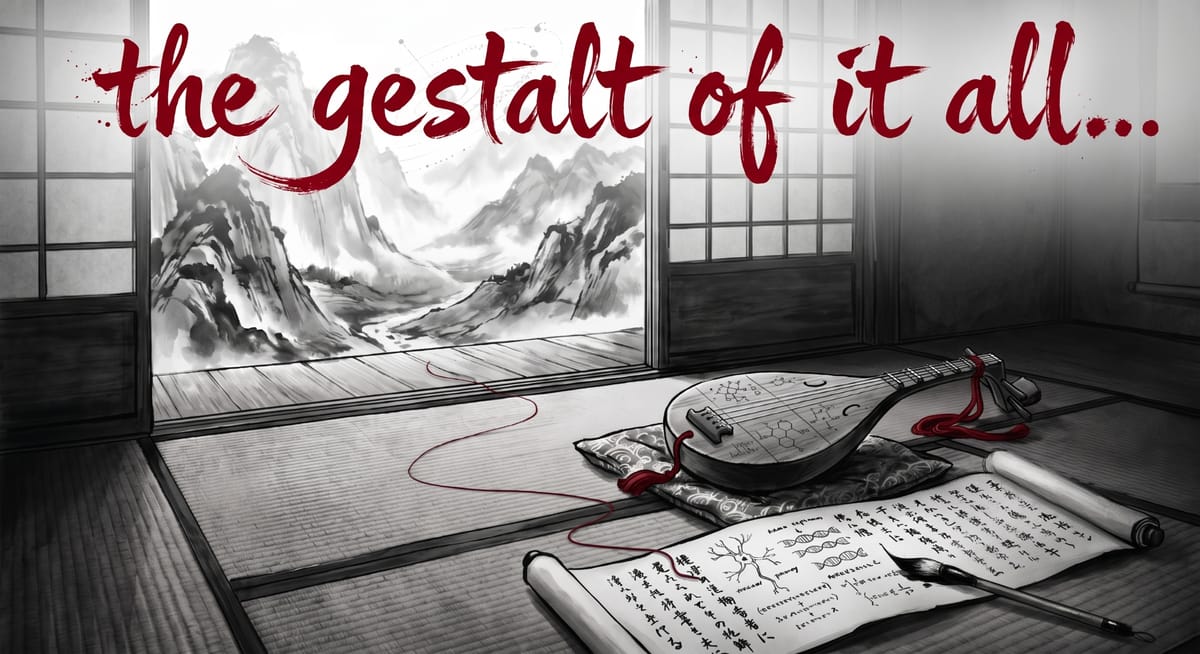
at seventy-seven, Ikkyu fell in love. the woman was a blind singer and composer named Lady Shin, late thirties when they met, a performer whose life had run along the edges of the entertainment quarters without, as far as the records can tell, ever having been formally of them. she was not his wife; Rinzai monks did not have wives. but by Ikkyu’s own account, and in the judgment of the Rinzai tradition ever since, she was the central relationship of his long life. they met around 1471. he lived another ten years. the poems he wrote for and about her, preserved in the Kyoun Shu and most fully translated into English by Sonja Arntzen, are the most direct, tender, and explicitly erotic dharma poems in the Japanese zen tradition. he did not write them to scandalize. he wrote them because Lady Shin was where his practice became fully legible to him. in Murphy’s reading, which has been the reading i have leaned on through this series, the relationship is where Red Thread Zen stops being a phrase and becomes a method.
this is the synthesis essay, and it has some work to do that the previous ones left open. it has to show how the refusal of the inka, the recovery of passion as substrate, and the geography of the unfiltered dharma, which were the three previous essays’ arguments, actually land somewhere. Lady Shin is where they land. the last decade of Ikkyu’s life is where, on his own account and on the record of the poems, Red Thread Zen became real.
the poems
the Kyoun Shu, the collection Ikkyu gave the sardonic title Crazy Cloud, runs to over a thousand poems over his long career. the late poems to Lady Shin are a distinct group inside it, written after their meeting and composed in a register that is unlike anything else in the collection. they are, first, explicit. they describe her body, their bodies together, the specific geography of their erotic life, in terms that embarrassed the Rinzai editors who came after him. they are, second, tender. they address her by name, by sensory detail, by the sound of her singing and the touch of her hands, with a directness the earlier poems in the collection do not have. they are, third, and this is the part that matters, doctrinally continuous with the rest of his work. they are not a departure from the Red Thread Zen teaching. they are the teaching’s most specific instance.
Arntzen’s translations, which are the most careful english versions available, do not soften this. the poems, in her English, carry the texture of the original. Murphy reads them as dharma material, not biographical material, and quotes from them to make points about practice. this is the right reading. they are poems of erotic life and they are poems of realization and they are the same poems. the tradition’s discomfort with them is a discomfort with the premise that those two things can be the same document.
one of the poems, in Arntzen’s translation, addresses Lady Shin and says plainly that she is his roshi; his teacher. he does not mean this ceremonially. he means that what she has shown him, about himself and about the practice, is what a teacher shows a student. the line is not hyperbole and not seduction. it is an accurate statement of what the relationship was doing. the teaching was happening in the relationship. that is what is meant, concretely, when Ikkyu’s red thread is called a practice rather than a slogan.
the missing female self
there is a phrase that recurs in the English-language reception of this period of Ikkyu’s life. the phrase is that in Lady Shin, Ikkyu located his own missing female self. it is a phrase worth looking at carefully, because it can land in a modern ear as a loose Jungian gesture, and i do not think that is what it was doing.
what it is doing, i think, is naming something specific about what the monastic life had cost Ikkyu and what the relationship gave back. the Rinzai monastery he had trained in, and every Rinzai monastery, was an exclusively male environment by design. the vow structure, the living arrangements, the teaching relationships, the modes of embodiment and affect that were rehearsed in that environment, were all shaped to a male-only ecology. this was not, in the fifteenth-century Japanese context, a controversial feature; it was the design specification. but it had consequences for the practitioner, and Ikkyu, reflecting at seventy-seven, seems to have understood one of those consequences very clearly. what the monastic life had required him to suppress was not only passion in the abstract. it was the specific texture of the self that could only emerge in relation to a woman who met him as himself. he had never had access to that self. he had, at most, lived adjacent to it. Lady Shin was where it became possible for him to be the person that relation called out.
the modern reader who has encountered unmasking, in its contemporary neurodivergent and trauma-informed literatures, will recognize this. the person who has spent decades in an environment that required a specific performance of selfhood, and who meets, late, another person who can meet them without that performance, often reports something like a discovery of a whole layer of the self they had not known was there. it is not a new self. it was there the whole time. but it was not addressable in the old environment, and when the new environment offers it an address, something that had been latent becomes lived.
this is what Ikkyu is describing, in his idiom, when he calls Lady Shin the place where his missing female self was found. the self was his own. the relationship was where it became audible. and the specific erotic texture of the poems is not peripheral to this recognition; it is the medium in which it was happening. the body in which he was meeting her was the body she had made newly available to him. the red thread he had taught about for decades had, late, become the thread of his own life in a way the teaching had not previously demanded.
the abbacy accepted
i told you in the first essay that the late Daitokuji abbacy would be its own problem. it is the problem i have to face here because it is, on the surface, a contradiction of everything the series has been arguing. Ikkyu refused the inka at thirty. he spent fifty years teaching outside the Gozan system. in 1474, at the age of eighty, he accepted the emperor Go-Tsuchimikado’s appointment as abbot of Daitokuji itself, the great Rinzai temple that had burned to the ground in the Ōnin War and needed to be rebuilt. he took the position and held it for the remaining seven years of his life.
the standard biographical reception treats this as either a late reconciliation with the institution or a pragmatic compromise by an old man. i do not think either reading is quite right. Daitokuji in 1474 was not the Daitokuji that had offered him the inka. it was rubble. the institution whose seal he had refused had been levelled by war, and what the emperor was asking him to do was not to accept certification but to oversee the physical reconstruction of a temple. those are two different acts. the first says, confirm me as a legitimate member of the system you represent. the second says, come build the building back from the ashes because you are the only teacher in the country with enough authority to hold the rebuild.
Ikkyu accepted the second. i do not read him as having changed his mind about the first. he was, by 1474, a man who had spent decades in relationship with Lady Shin, who had integrated the self the refusal had required him to walk out into, and who could accept the work of rebuilding without needing to pretend the rebuilt structure would not make the same institutional mistakes again. he took the job, raised the money, supervised the construction, and died before it was finished. what he was doing, at the end of his life, was the work that the early refusal had given him the standing to do. the refusal and the acceptance are not in contradiction. the refusal made the acceptance meaningful.
there is, i think, a lesson inside this that the series has been circling. the refusal of the institution’s certification is not the same as the refusal of the institution’s material life. the institutions have to be rebuilt when they fall. someone has to do it. the person who has spent decades outside the institution’s certifying structure is, sometimes, the only person whose hands are clean enough to hold the rebuild. Ikkyu accepted the chair because it was not the chair he had been offered at thirty. it was a chair made of ashes, and it was an offer to help rebuild on different premises, and he took it.
what integrates
i want to land the essay and the series on what this whole arc has, i think, been arguing. it has been an arc about a specific kind of integration. the integration is not the transcendence the standard monastic model aims for. it is not the smoothed, harmonized, serenely managed self the contemporary wellness institutions are in the business of producing. it is the integration of a specific human being who has walked out of a certifying structure that could not certify him accurately, who has stayed in contact with the intensities of his own embodied life, who has found the people his practice required him to find, and who, late in the life, had become one person doing one practice in one life rather than a divided self managing several registers of pretense.
this is what Red Thread Zen, as Murphy lays it out and as Ikkyu lived it, actually produces. it does not produce a purified self. it produces a whole self, which is a different thing. the whole self is not tidier than the divided self; in some ways it is messier, because it is not managing its layers through suppression. what the whole self has is coherence. it is the same person in the brothel as in the temple. it is the same person mourning as loving. it is the same person refusing the seal at thirty and accepting the rebuild at eighty. the coherence is not a style. it is what the practice was for.
for the reader whose authentic affect has been treated, in the environments they have passed through, as a problem to be smoothed out, i want to say plainly what i think the series’s final claim is. the problem is not that you have a defect the smoothing could correct. the problem is that the smoothing is not the direction the practice, any practice, can actually be done in. the red thread is what the practice runs on. what you have been trained to suppress is the substrate of the clarity you have been promised in exchange. Ikkyu knew this in the fifteenth century. Murphy knows it now. i am, in my own way, trying to know it too.
the end of his life, as the Rinzai records have it, was quiet. he died at Daitokuji in 1481, with the rebuild underway, having arranged for Lady Shin’s care, having written his last poems, and having, by all accounts, been at peace. the final poem in the Arntzen collection, which may or may not actually have been his last, says something like, i will disappear into the place where i have always been. that is the integration the practice was aiming at. the self was there all along. the work was coming into accurate contact with it.
there are more essays to write about him, in other registers, for other purposes. there will, i hope, be people after me who write them. for now, this is what the short run of the series had to offer. the refusal of the seal, the recovery of passion as substrate, the geography of the unfiltered dharma, and the integration that comes, if it comes at all, late and through specific relationships with specific people, none of which the certifying structures could have produced or predicted. Ikkyu walked out of the monastery at thirty and found, at seventy-seven, the person the walk had been toward. that is the red thread. it does not cut, and it does not fray. it runs.
this is part four of the red thread, a research series on Ikkyu Sojun and what his refusal still makes possible.