
Attraction Is Prediction Error Management
Chemistry. Spark. That thing you can’t explain but you know it when you feel it. The person walks into the room and something in your chest rearranges itself. Not a thought. A reorganization. Your prediction engine, running quietly in the background, suddenly has something to work with.
Everybody talks about attraction as though it’s a mystery; as though some combinations of people generate heat and others don’t, and the best you can do is notice it when it happens and hope it lasts. Evolutionary psychology offers mate value and fitness indicators. Pop psychology offers “types” and chemistry. Your friends offer “you just know.”
None of that is wrong. All of it is incomplete. Active inference says something more precise about attraction, and the precision explains not only who you’re drawn to but why you keep being drawn to the same kind of person, and why the person who is “good for you” sometimes feels like nothing at all.
The Prediction Error Sweet Spot
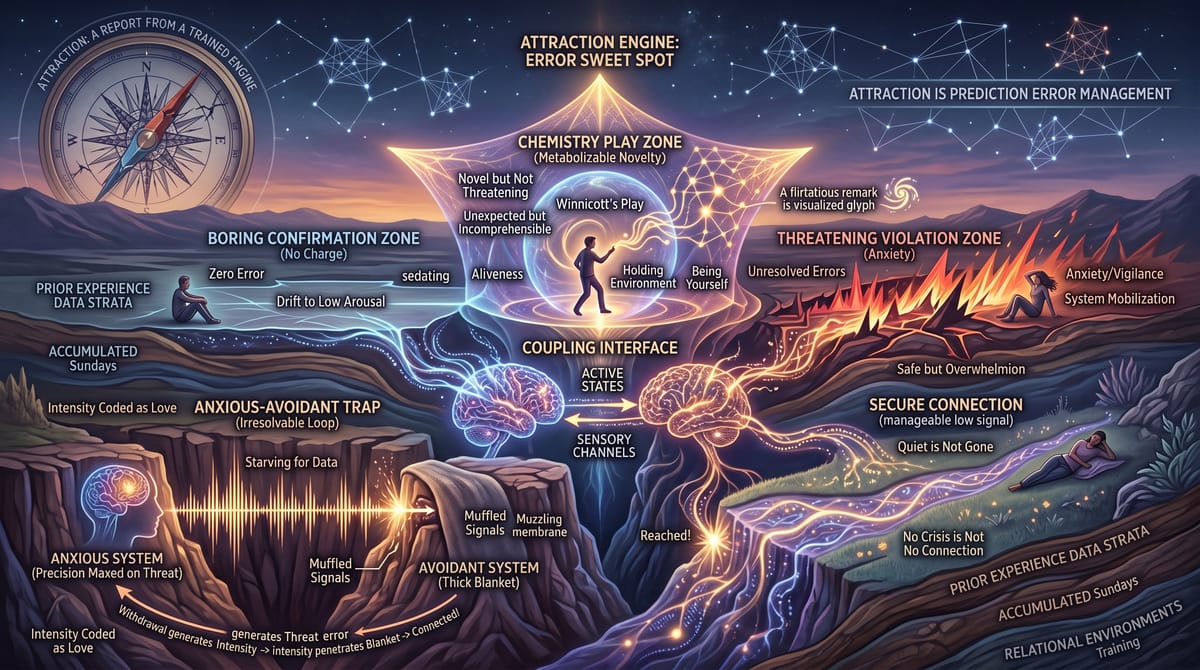
Attraction, in the active inference framework, is substantially about prediction error profiles. You are drawn to people whose behavior generates a specific ratio of prediction confirmation to prediction violation.
Too much confirmation and the system gets bored. This is the perfectly nice person who does everything right and generates zero charge. Their behavior matches your model so completely that the prediction engine barely has to work. No error, no updating, no engagement. The system drifts toward low arousal because there’s nothing to process. Confirmation is calming, but unrelenting confirmation is sedating. The system needs some error to stay alive.
Too much violation and the system gets threatened. This is the person who is so unpredictable that your prediction engine can’t build a stable model. Every interaction generates errors the system can’t resolve. The engine runs hot, burning energy, never settling. The sensory data keeps arriving and none of it matches anything in the existing model. This feels like anxiety, not attraction; though the line between them is thinner than most people want to admit.
The sweet spot is someone whose behavior mostly confirms your model but generates violations in ways your system can integrate. They’re familiar enough that the prediction engine can run efficiently; it knows, roughly, what to expect. And they’re surprising enough that the engine stays engaged; it has to keep updating, keep processing, keep working. The errors they generate are novel but not threatening. Unexpected but not incomprehensible. The system can metabolize them, integrate them into the model, and expand its predictive range in the process.
That metabolizable surprise is what people mean when they say chemistry. It’s prediction error in the sweet spot. Enough to be alive. Not enough to be dangerous.
Here’s a concrete version. You’re on a third date with someone. The first two were good; easy conversation, the models mostly aligned, confirmation and comfort. Now, on the third, they say something you didn’t expect. Not something alarming; something that reveals a perspective you hadn’t mapped. A way of seeing the world that your model didn’t predict. Your prediction engine registers the error. The error is small enough that the system doesn’t mobilize; no threat, no defense. But it’s large enough that the system has to work. It has to update. It has to integrate this new data point into its model of who this person is. And in that updating; in the moment where the model stretches to accommodate something genuinely new; the system generates a feeling. Not anxiety. Not boredom. Interest. Aliveness. The specific pleasure of a prediction engine encountering novelty it can handle.
Now contrast this with the date where they say something you didn’t expect and the system mobilizes. The prediction error is too large. The model can’t stretch far enough. The system reads the gap as threat rather than novelty, and the aliveness tips into vigilance. Same mechanism, different magnitude. The line between attraction and anxiety is not a feeling; it’s a prediction error magnitude that your system either can or cannot metabolize.
This is why the “type” you’re attracted to is so consistent. It’s not that you have a type in the way people usually mean it; a list of traits, a physical template, a personality spec. You have a prediction error profile. A specific range of surprise your system can metabolize. People who fall inside that range feel like chemistry. People who fall outside it feel like either nothing or threat. The range was set by every relational environment you’ve passed through, and it’s as specific as a fingerprint.
Winnicott’s Play
This is where Winnicott unlocks the framework in a way the math alone can’t.
Winnicott distinguished between two modes of being. In one mode, you’re complying; matching the environment’s demands, running the model that generates the fewest errors, keeping the system stable. In the other mode, you’re playing; experimenting, exploring, tolerating the uncertainty of not knowing how things will land, generating prediction errors on purpose because the space feels safe enough to do so.
Playing is not recreation. Playing, in Winnicott’s framework, is the primary mode through which the self develops. It requires transitional space; a space that is neither fully internal nor fully external, where reality can be experimented with rather than merely survived. And it requires a holding environment; someone or something that makes the prediction errors generated by play feel survivable rather than catastrophic.
Now map this onto attraction.
The person you’re drawn to is the person whose presence creates transitional space. With them, you can play. You can say the thing you weren’t sure you’d say and discover what happens. You can show a part of yourself that doesn’t come out with everyone and find out whether it lands. You can generate prediction errors in each other; the flirtatious remark, the unexpected vulnerability, the joke that tests a boundary; and both systems can integrate the errors without collapsing.
This is the experience people describe as “being yourself” around someone. It’s not that the person removes all prediction error. It’s that the prediction errors they generate, and the ones you generate in return, feel like play rather than threat. The holding environment is present. The space is transitional. Exploration is possible.
Esther Perel has described the fundamental tension in long-term relationships as the pull between security and adventure; the need for safety and the need for novelty. In the active inference framework, this is the tension between confirmation and violation. The secure base of the relationship provides enough prediction confirmation that the system can tolerate the errors generated by surprise, by play, by the other person’s irreducible otherness. When both are present; security and surprise, confirmation and play; that’s where desire lives.
The Anxious-Avoidant Trap
Here’s the spicy part. The part people screenshot and send to their friends.
The anxious-avoidant pairing is the most common dysfunctional relationship pattern in clinical practice, and active inference explains precisely why it’s so hard to escape.
The anxiously attached person’s prediction engine runs high precision on threat-related signals. Every ambiguous cue gets interpreted as potential abandonment. The system is starving for data; for confirmation, for reassurance, for any signal that the other person is still present and the prediction of safety is correct.
The avoidantly attached person’s prediction engine runs low precision on relational signals. Social data is deprioritized. The blanket is thick. Signals from outside arrive muffled, at low volume, often below the threshold of conscious processing.
Now put these two systems together.
The anxious person’s intensity; their texts, their bids, their need for reassurance; generates enormous signals. These signals are so strong that they occasionally break through the avoidant person’s thick blanket. For the avoidant person, this is one of the only relational experiences that registers at all. Normal-volume bids bounce off the blanket. The anxious person’s amplified bids push through. And when they do, the avoidant person feels something they almost never feel: reached. Connected. The signal penetrated the wall, and for a moment, the system registered that another person is there.
That moment feels like the most intense connection the avoidant person has ever experienced. Because it is. Their system is calibrated to receive almost nothing, so when something gets through, the contrast is staggering.
Meanwhile, the anxious person is experiencing the avoidant person’s withdrawal as the most activating signal their system can receive. Every hour of silence, every unreturned bid, every moment of emotional distance generates a massive prediction error in the anxious system. The precision on threat is maxed. The error signal is deafening. And here’s the trap: that activation feels like intensity. And intensity, in the anxious person’s model, is coded as love.
They felt this before. In the holding environment that trained their prediction engine. Love was intense because it was unreliable. Connection was electric because it was intermittent. The prediction errors weren’t a bug of the relationship with the caregiver; they were the relationship. The system learned that love feels like this: the desperate, consuming, never-resolved error signal of a need that is sometimes met and sometimes not.
So both systems are chasing prediction errors they can’t resolve. The anxious person chases the avoidant because the withdrawal generates the specific class of prediction error their system interprets as love. The avoidant person stays with the anxious person because the intensity generates the only signal strong enough to penetrate the blanket. Both systems are trapped in a loop that generates maximum prediction error and minimum resolution. And the irresolvability is the glue. Resolve the errors and the attraction disappears, because the attraction was the errors.
This is why the anxious person leaves the avoidant for a secure partner and feels nothing. The secure partner generates small, manageable prediction errors. Low signal. Low drama. The anxious system, calibrated for intensity, reads this as flatness. No chemistry. No spark. What it’s actually reading is: no unresolvable prediction errors. And the system has mistaken the absence of crisis for the absence of love.
Recalibrating the Compass
The fix is not to find someone who generates the “right” amount of prediction error. The fix is to recalibrate what your system registers as attraction versus threat versus boredom.
This is a precision-weighting problem. The anxious person’s system has the precision dial turned too high on one class of signals (withdrawal, ambiguity, absence) and too low on another (consistent presence, reliability, steady warmth). The avoidant person’s system has the precision turned too low across the board for relational data. The fix, in both cases, is recalibration. Not choosing differently. Perceiving differently.
What this looks like in practice: the anxious person learns to notice when the activation they’re feeling is the old model firing rather than a legitimate signal from the current relationship. They learn to sit with the discomfort of low prediction error; the uncanny flatness of a person who actually shows up consistently; and let the system adjust.
This is harder than it sounds, and it’s worth being honest about why. The flatness doesn’t feel like healing. It feels like loss. The anxious person sitting with a secure partner on a quiet Sunday morning, no crisis brewing, no signal to scan for, no prediction error to chase; that person is experiencing the withdrawal of a pattern their system has been running for decades. The intensity was not just a feature of bad relationships. It was the system’s operating frequency. Without it, the system doesn’t know what to do with itself. The Sunday morning feels empty. The partner feels distant even though they’re right there. The absence of alarm feels, to a system trained on alarm, like the absence of love.
Sitting with this is the work. Not fixing it. Sitting with it. Letting the system learn, through accumulated Sundays, that quiet is not the same as gone. That a partner who doesn’t generate crisis is not a partner who doesn’t generate connection. That play can happen at low volume. The prediction engine doesn’t recalibrate in a week. But with repeated exposure to consistent, low-drama connection, the precision weights start to shift. The system learns, slowly, that the absence of crisis is not the absence of connection.
The avoidant person’s recalibration runs in the opposite direction. They learn to notice when the thick blanket is blocking signals they actually want to receive. They learn to practice turning up precision on bids for connection, even when the system’s first impulse is to deflect. They learn that letting a signal through the blanket doesn’t require dismantling the blanket. It requires opening a channel, selectively, for specific kinds of data from a specific person. The discomfort here is different; not the emptiness of missing intensity, but the exposure of being seen. The avoidant person who lets a bid through and responds with something real is experiencing a vulnerability their system has been organized to prevent since adolescence. Every instinct says close the channel. The practice is to hold it open five seconds longer than is comfortable.
Neither of these recalibrations happens through willpower. They happen through the mechanisms described in Chapter 7: new sensory evidence, tolerable prediction errors, a holding environment that makes the recalibration survivable. But the first step is recognizing that attraction, the felt sense of being drawn to someone, is not a reliable compass. It’s a report from a prediction engine that was calibrated across every relational environment you’ve passed through.
Your compass isn’t broken. It’s pointing toward the prediction errors your system was trained to chase. The question is whether those are the errors you actually want to spend your life trying to resolve.