
Co-Regulation Is Coupled Inference
You’ve been told to co-regulate. Every couples therapist says it. Every parenting book says it. Be the calm in the room. Regulate yourself so your partner can regulate. Hold the space. Be the steady one.
Nobody tells you what co-regulation actually is. Mechanistically. What’s happening between two nervous systems when one person’s calm helps the other person find theirs. What’s happening when it fails; when you’re being as calm as you can possibly be and the person across from you is still spiraling, and your calm seems to make it worse rather than better. What’s happening when co-regulation works so well it feels like magic, like you and this person share a nervous system, like their breathing synced to yours without either of you deciding it.
Active inference explains all three. And the explanation changes how you do it.
Two Blankets, One Interface
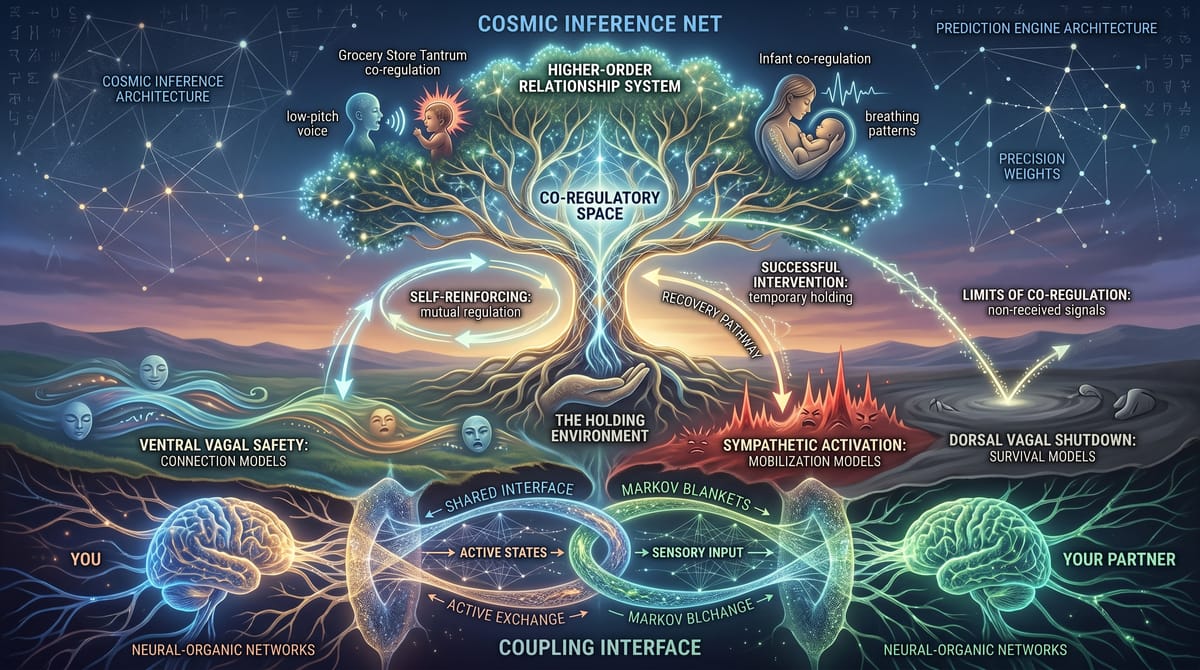
Co-regulation, in the prediction framework, is two active inference systems coupling their prediction loops through a shared interface. That’s it. That’s the mechanism.
You have a Markov blanket. Your partner has a Markov blanket. Where your active states become their sensory inputs and their active states become yours; that’s the coupling interface. And as we saw in Chapter 3, when two systems couple this way consistently, they form a higher-order system with its own blanket; the relationship, operating as a superordinate entity. The co-regulatory space lives inside that shared blanket, and this is where two prediction engines exchange data in real time.
When you’re co-regulating, here’s what’s actually happening: your nervous system is using your partner’s signals as sensory input to update its own predictive model. Their facial expression, their tone of voice, their body language, the rhythm of their breathing, the tension or ease in their body; all of this crosses the interface and enters your prediction engine as data. Your system processes it, generates a prediction about the state of the relationship, and adjusts its own autonomic state accordingly.
And your partner’s system is doing the same thing with your signals. Your face, your voice, your posture, your breath. Every signal you emit crosses the interface and becomes input for their prediction engine.
This is bidirectional. Constant. Mostly unconscious. And it has a specific dynamic.
When both systems are in ventral vagal; when both prediction engines are running connection models and both vagal brakes are engaged; the loop is self-reinforcing. Your calm is data for their system. Their system processes it, predicts safety, stays ventral, and emits calm signals back. Which your system processes, which confirms the safety prediction, which keeps you ventral. A positive feedback loop of mutual regulation. Both systems settling into the same predictive state through the continuous exchange of signals across the shared blanket.
This is what it feels like when a relationship is working. Not drama-free; prediction errors still occur. But the baseline state is two coupled systems running compatible models, confirming each other’s safety predictions, maintaining ventral vagal engagement through the continuous exchange of regulatory signals. It feels easy. It feels like home. It feels, if you grew up in a good-enough holding environment, like the most natural thing in the world. Because it is. It’s the adult version of what your mother’s nervous system did for yours.
Why “Just Be Calm” Doesn’t Work
Here’s where it breaks down.
Your partner comes home activated. Something happened at work. They’re in sympathetic; not full fight-or-flight, but the system has dropped out of ventral vagal. Their breathing is shallow. Their face is tight. Their voice has lost its prosody; it’s flatter, sharper, the melody is gone. They’re generating signals from a mobilized nervous system.
Those signals cross the interface and enter your prediction engine.
Now your system has to process this. If you’re securely attached and your own vagal brake is well-calibrated, your system generates a prediction: they’re activated but this is temporary, I can hold the space, this will pass. Your system stays ventral. You emit calm signals. Your voice is warm. Your face is soft. Your breathing is slow. These signals cross the interface back to their system and provide a regulatory anchor; sensory evidence that safety is available, that the ventral zone is accessible, that someone on the other side of the blanket is holding steady.
This is successful co-regulation. Your regulated state provides the sensory input their prediction engine needs to update from “the world is threatening” to “this specific environment is safe.” You become, temporarily, their holding environment. Your nervous system does for them what the good-enough mother’s nervous system did for the infant.
But.
What if their system is too far gone? What if they’re not in sympathetic activation but in dorsal vagal shutdown? If their system has dropped to the oldest circuit, the freeze response, then the blanket has thickened dramatically. The sensory channels for social engagement have gone offline. Your warm voice, your calm face, your regulatory breathing; they’re hitting the outside of a blanket that has closed for business. You’re broadcasting on a frequency their system has turned off.
This isn’t rejection. It’s not them choosing to shut you out. It’s a prediction engine that has determined the current prediction error is too large to resolve through social engagement and has dropped to the survival strategy that predates social connection entirely. Dorsal vagal preceded ventral vagal by millions of years of evolution. When the system drops that far, the newer circuits go dark.
And here’s the part nobody tells you: when your co-regulatory signals aren’t landing, your own system starts generating prediction errors. You predicted that your calm would reach them. It didn’t. Error. You predicted that they’d soften when you softened. They didn’t. Error. You predicted the loop would catch, the way it usually does, and it’s not catching. Error after error after error.
If your own system isn’t well-calibrated, those errors start pulling you out of ventral vagal too. You get frustrated. You get scared. You match their state instead of holding your own. Now both systems are activated, both are generating error signals, and the co-regulatory loop has become a co-dysregulatory loop. The same mechanism that makes co-regulation so powerful makes co-dysregulation so destructive. Coupled inference works in both directions.
Here’s what this looks like at 11pm on a Thursday. Your partner is shut down. You’ve tried warmth, you’ve tried patience, you’ve been breathing deliberately for twenty minutes. Nothing is landing. And you can feel your own system start to slip. The frustration isn’t a moral failure; it’s your prediction engine generating an error it can’t resolve. You predicted your regulation would reach them. It didn’t. The gap between prediction and reality is widening, and your own vagal brake is starting to release. Your voice gets tighter. Your breathing shallows. You say something with an edge you didn’t intend. Now their system registers the edge; more threat data, further shutdown. Your system registers their further withdrawal; more error, more activation. Twelve minutes ago you were the holding environment. Now you’re part of the cascade.
This is not failure. This is the physics of coupled systems. The regulated partner isn’t an infinite resource. The holding environment is a state, not a personality trait, and states shift. When your own system starts to go, the most important intervention is recognizing it: my vagal brake is releasing. I’m about to become part of the problem. Step out. Breathe. Reestablish your own regulation before trying to provide it for someone else. You can’t lend a nervous system you’ve lost access to.
Reading the Predictive State
Sue Johnson, the developer of Emotionally Focused Therapy, builds her entire clinical approach on the idea that partners are each other’s primary affect regulators. Stan Tatkin, whose Psychobiological Approach to Couple Therapy works with the nervous system directly, teaches couples to read each other’s arousal states and respond from the body, not the mind.
Both of them are describing coupled inference without using the term. And both of them identify the same critical skill: you have to know which predictive state your partner is in before your intervention has any chance of working.
This is a learnable skill, and it starts with the body rather than the words.
Ventral vagal looks like: full facial expression, prosodic voice (melody, variation), relaxed shoulders, steady gaze, breathing that’s visible in the belly. The system is online. Social engagement is available. Co-regulatory signals will land. This is the state where you can have a conversation, where words mean what they say, where both systems are running connection models.
Sympathetic activation looks like: tight jaw, flattened voice, restless movement, shallow breathing high in the chest, eyes scanning or avoiding. The system has mobilized. Social engagement is compromised but not offline. Co-regulatory signals can still land, but they need to come through the body more than the words. This is the state where tone matters more than content, where physical proximity (if welcome) does more than logic, where matching their energy slightly before slowly bringing it down works better than arriving with a calm that feels dismissive.
Dorsal vagal looks like: flat affect, monotone voice, slumped posture, minimal eye contact, shallow or barely visible breathing. The system has shut down. Social engagement is offline. Words aren’t processing. Co-regulatory signals from outside the blanket are not being received. This is the state where you don’t try to fix anything. You stay present. You keep your own system regulated. You wait. You let your physical presence; warmth, proximity, the quiet rhythm of your breathing; provide the minimal sensory input that might, eventually, help their system start to come back online.
The critical distinction: co-regulation isn’t one thing. It’s different interventions for different predictive states. Trying to have a “productive conversation” with someone in dorsal vagal is like trying to send email to a computer that’s turned off. The hardware isn’t running. You have to help the system come back online before the software can process anything.
The Winnicott Move
Here’s where the holding environment concept extends into adult relationships.
When you co-regulate with your partner, you are becoming their holding environment. You’re doing the same thing the good-enough mother does for the infant: providing a regulated nervous system that the other person’s prediction engine can use as a template. Your ventral vagal state, transmitted through your face, your voice, your body, your breath, becomes sensory evidence their system can use to update from threat to safety.
And like the good-enough mother, you don’t have to do this perfectly. You have to do it enough. You can feel your own activation rising. You can lose the thread for a moment. You can step out to take a breath. The holding environment isn’t a performance of unshakeable calm. It’s a system that’s regulated enough, often enough, that the other system can use it as an anchor.
Winnicott’s good-enough mother isn’t unflappable. She’s a person with her own prediction errors, her own activation, her own bad days. What makes her good enough is that her system returns to regulation reliably. The infant’s prediction engine builds its model not on the caregiver’s perfection but on the caregiver’s recovery. She gets activated; she comes back. She misses the cue; she repairs. The prediction that develops is not “the world is always safe” but “the world becomes safe again.” That’s the prediction that underpins secure attachment. And that’s the prediction you’re teaching your partner’s nervous system when you co-regulate imperfectly but consistently.
This is the realistic version of what the therapists are asking you to do. Not be the unbreakable calm. Be the system that comes back. Be the holding environment that tolerates its own prediction errors and returns to ventral vagal reliably enough that the other system can learn to trust the return.
Co-Regulation with Children
Everything above applies to parenting, amplified. Because the child’s prediction engine is still being built. The architecture is still forming. The precision weights are still being set.
When your child is dysregulated; tantrum, meltdown, fear, rage; their system has dropped out of ventral vagal. Depending on the child’s age and the intensity of the activation, they may be in sympathetic mobilization (screaming, hitting, running) or dorsal vagal shutdown (going silent, dissociating, going limp).
The parenting advice says: co-regulate. Stay calm. Be present. Don’t match their energy.
The prediction framework says: your regulated nervous system is the sensory input their prediction engine needs. Your breathing, your tone, your physical presence; these are the data points their system will use to update from “the world is threatening” to “the world is safe again.” You are, in this moment, doing exactly what the holding environment does. You are being the first Markov blanket they didn’t build.
And the same caveats apply. If they’re in dorsal vagal, your signals may not be landing. Don’t escalate. Stay present. Keep breathing. Let your physical proximity do the work while the software catches up. If they’re in sympathetic activation, meet them with slightly more energy than pure calm (pure calm can feel dismissive to an activated system) and then slowly, slowly, bring it down. Let your body lead. Their system is reading your body, not your words.
Here’s the concrete version. Your four-year-old has a meltdown at the grocery store because the cereal they wanted is gone. They’re on the floor. Sympathetic activation; screaming, limbs everywhere, face red. Your system wants to match them. The embarrassment of the public setting adds its own prediction error. Every adult eye in the aisle is generating social data that your prediction engine is processing: judgment, incompetence, failure. Those signals are from outside the blanket. Recognize them. Set them aside. The only signal that matters right now is the small system on the floor that needs your regulated nervous system as a template.
Get low. Not looming; low, at their level. Let your voice drop in pitch and slow in rhythm. Don’t reason with them; the cortex isn’t driving this, and words aimed at the cortex bounce off a system in sympathetic activation. Let your body do the work. Slow breath, visible. Gentle touch if they’ll accept it. Your diaphragm, moving slowly, providing the regulatory input their system is too young to generate for itself. Wait. Let the signal travel across the interface. Their system will find yours if yours is steady enough to find.
Every successful co-regulatory moment is a data point for their prediction engine. It’s teaching: when the world gets too much, there is someone whose nervous system I can borrow. There is a holding environment that holds. The prediction errors are survivable because someone is holding the blanket. You’re not just managing a tantrum. You’re installing the architecture that will determine whether this person, twenty years from now, can hold a relationship together when the prediction errors start cascading.
The Limit of Co-Regulation
There is a limit, and it matters.
You cannot co-regulate someone whose system won’t accept your signals. You cannot co-regulate someone whose blanket has closed so completely that nothing from outside penetrates. You cannot co-regulate someone whose prediction engine is running a model in which your presence is the threat.
This is the reality of disorganized attachment in the co-regulatory space. If your partner’s prediction engine learned that the holding environment was the source of danger; if their mother’s nervous system was simultaneously the regulator and the threat; then your attempts to co-regulate may activate the paradox rather than resolve it. Your calm may trigger fear because calm was the precursor to chaos. Your proximity may trigger withdrawal because closeness was the precursor to harm.
When this happens, you have not failed. The mechanism has hit a limit that the mechanism itself can’t resolve. This is where the co-regulatory circuit needs help from outside the couple system; a therapist, a structured intervention, a third nervous system that can hold both of you while the couple’s system learns to hold itself.
Co-regulation is powerful. It is the primary mechanism through which two people build a shared holding environment, through which adult prediction engines learn to update in real time, through which love moves from the body of one person into the body of another. But it is not omnipotent, and treating it as such puts an impossible burden on the regulated partner and generates shame in the dysregulated one.
Sometimes two blankets need a third blanket. That’s not failure. That’s engineering.